In 1969, a man walked on the moon, a half million young people peacefully gathered four days on a hillside field near Woodstock in upstate New York, and 11,616 American troops died in Vietnam. Technology, youthful hope, and tragedy, all vying for the top spot. That same year songs from the 5th Dimension’s album, Age of Aquarius, an ode to the belief the world was entering a new age of love, light, and understanding ruled the radio airwaves, and I was a big fan.
That summer was a bit of a lost time in my life. I mostly worked in the hay fields, free finally of the banality of high school, but fearful of going away to college. I spend a lot of time just driving around on the country backroads, listening to the radio. Whenever the “Wichita Lineman” came on, I’d pull over and let the feelings conjured up by the song roll over me.
In September of that same momentous year, I left rural southern Illinois to attend Oakland City College in Indiana, a school year that marked the institution’s second highest enrollment up until that time. At first, I was overwhelmed, worrying about how I would ever find a place in this dynamic, noisy, and strange new world.
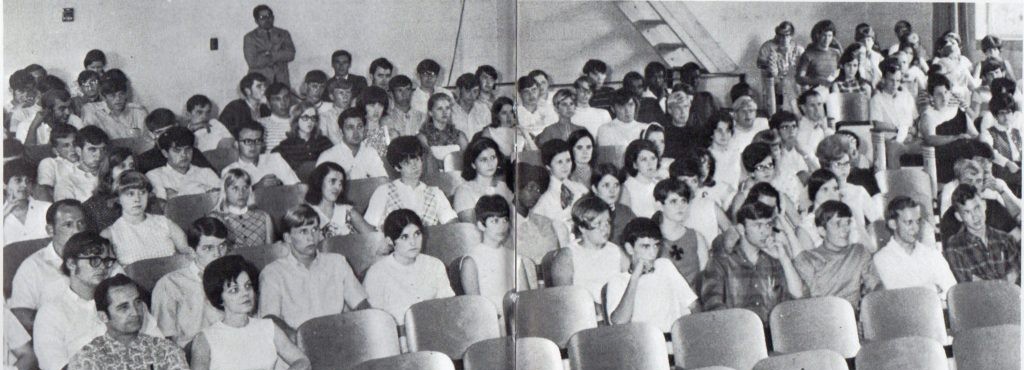
I am in the right, back corner at one of the 1969 OCC freshmen orientation meetings.
I soon discovered most of the students came from the rural region where the school was located, a region that was somewhat culturally deprived like the place I had come from. Over the decades the college had been a primary force for helping these first-generation students transition to the bigger world; the breadth of courses opening us up to the great ideas and thinkers of the world, at least for those paying attention.
But there was “something happening here.” With the war bringing in more male students fearful of the draft, many of them from places outside the region, and a growing trend of newspapers and media taking a more aggressive role in defining culture, new tensions began to appear even on our backwater campus. I soon discovered that, to a smaller degree, you could pretty much find everything happening at our campus as you could at any big college or university. Meanwhile, I began to try and find my way.
Leaves were turning on the wooded campus when the first all-school event took place, a periodic and mandatory convocation that brought in some important speaker. Ordinarily, these were boring events that have left hardly a scrap of memory. Coming out of the old gym after these proceedings, I often experienced a lingering headache, the result of my nose being assaulted by the fragrance of Brute aftershave cologne worn by scores of hopeful freshmen males.
But in the fall of 1969, that very first all-school convocation proved an exception to the rule.
A nation-wide Moratorium, the largest anti-war protest in history of the nation, took place that day, with colleges and universities at the forefront. The day before, an Evansville newspaper headline, Tri-state Campuses Brace for Moratorium,” suggested the event would cause great disruption at colleges in the region. I was a newspaper junky. I prepared for the worst.
In reality, six or so students marched into the college’s ancient gym, wearing black armbands and singing an off-key version of “Blowing in the Wind” and other songs to protest the Vietnam War. Eight rows of worn wooden bleachers rode up the two longer side walls, and the protestors, wearing black armbands, soon stationed themselves at the top row of the east side of the gym, one strumming on a guitar in front of a painted-out window.
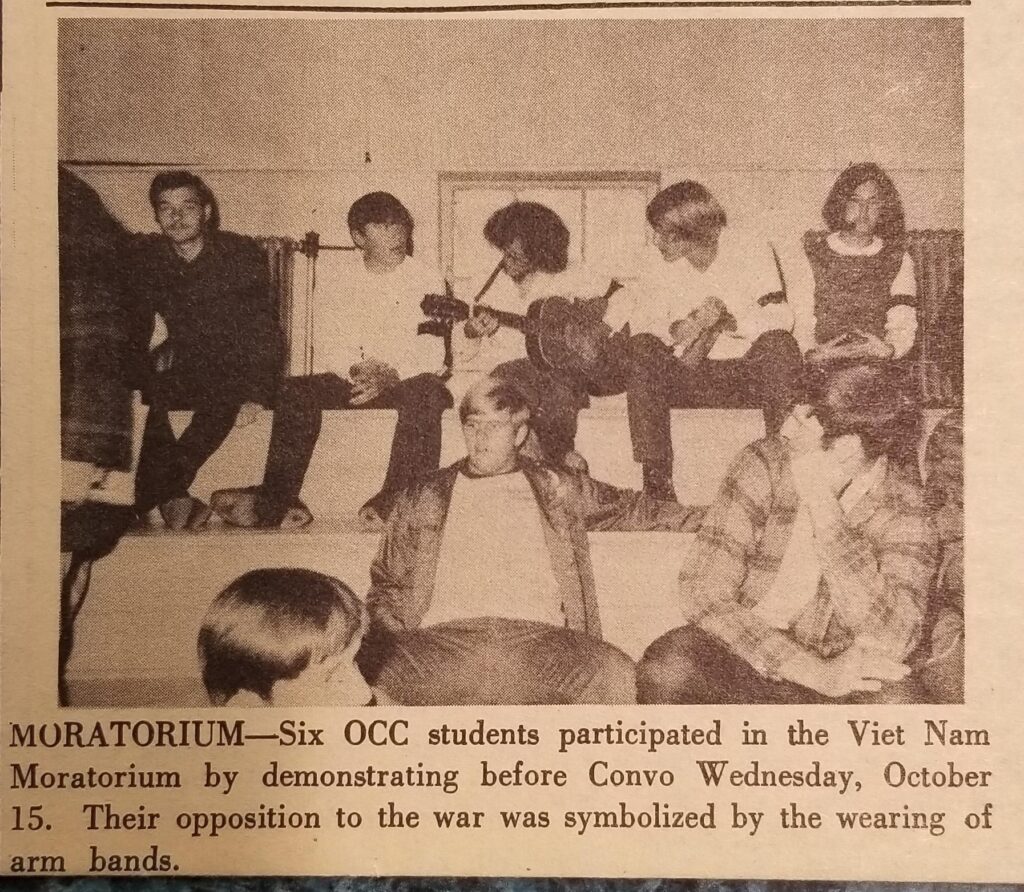
War protestors, Oakland City College style, 1969
I cannot remember who the convocation speaker was that day. I can tell you, however, that there ended up being a lot of sore necks the next day, including mine, from craning around and watching what was happening on that upper bleacher. The college newspaper reported later that week that this small group was participating in a national Moratorium against our nation’s involvement in Vietnam. On many other campuses, the Moratorium basically shut down classes for a short duration. Not so at OCC.
The day before, the same group of protestors who had graced our convo and, for once, made the event interesting, had gathered in front of the school gym to sing anti-war songs, their youthful faces filled with righteous confidence. Their actions and strong beliefs scared me a bit. In the rural southern Illinois region where I came from, one did not question authority.
I stopped and watched the group from a safe distant, me, a green freshman, waiting to see what the city police or campus authorities would do, and, in the process, missing cafeteria hours. No one in authority showed up. The local Princeton paper, however, did interviews and produced a writeup, noting OCC was not on the forefront of anti-war protests.
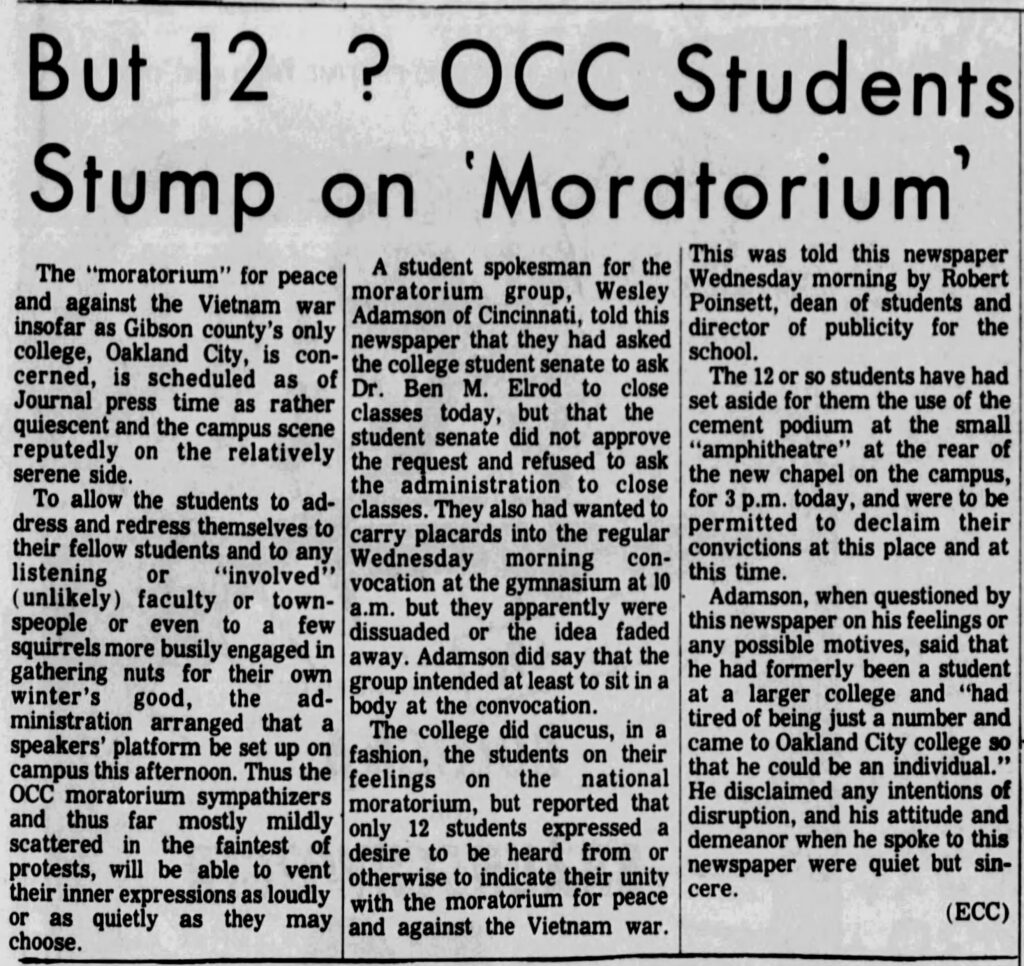
The Princeton Clarion’s report of the OCC anti-war protest in 1969.
Other than the black arm bands and singing activity, and a few letters to the school newspaper against the war, students at OCC did not frequently discuss or argue about Vietnam as far as I remember, certainly not in the way they did on most other campuses. Interestingly, however, OCC would endure a high level of student agitation in the early 1970s, driven by both the counter-culture mood of that era and internal dynamics unique to the school. Looking through college newspapers, you can see its beginnings in the mid 1960s.
In 1964, the student editor-in-chief for the Oakland City College Collegian, Joanne Hash, had gotten into a disagreement with the administration and with the college’s sponsor, The General Association of General Baptist. The latter group had condemned several OCC students, going on record as-
Disapproving of the looseness of conduct, manifested by some of the students of Oakland City College as being contrary to the high types of ethics and testimony of a Christian institution, namely, the smoking in college buildings, the playing of cards, the wearing of short shorts as lounging or street apparel, and the reported drinking of some members of the student body.
Hash wrote a long-impassioned response to the General Baptists leaders’ accusations in the school newspaper entitled Saints and Sinners, noting in part, “I believe that Oakland City College students, though occasionally faltering, are capable of coping honorably and honestly with the need to make decisions, just as generations of students before them have made theirs.”
Two things happened after her editorial came out. Oakland City College’s academic Dean, the beloved Dr. Shepard, wrote a longer respond to Hash’s arguments, summing up, “I regard the duty of college administrator as being precisely the same as that of a parent.” Then, in the next issue of the Collegian, it was announced that Joanne Hash would not be back as editor for the next term. The divide between students and school leadership only grew.
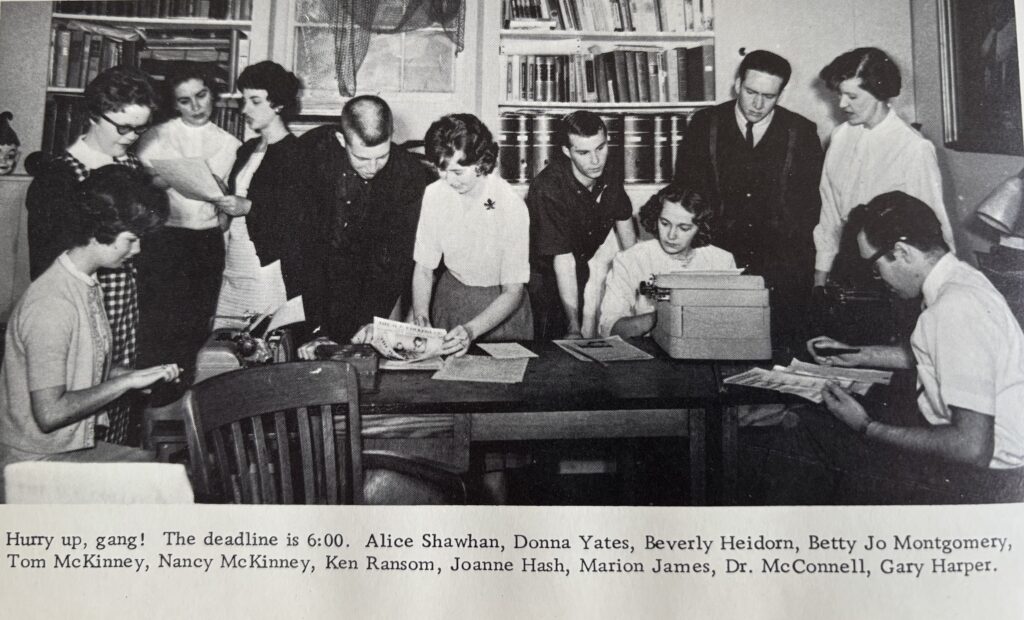
Courageous Joanne Hash, OCC Collegian editor-in-chief at her typewriter in 1964.
_______________
During the mid to late 1960s, the school’s conservative leadership still maintained and enforced long established traditions and standards. These conservative ideas included no dancing on campus, dress codes, and strict dorm hours, among other rules. While much of the student body, including myself, came from conservative areas and backgrounds, the values of the counterculture had still soaked down to influence many OCC students’ sense of freedom—their right, and even their duty to question authority. This tension would lead to student unrest, OCC style, by the early 1970s.
The essential entity at the college which strongly drove such student unrest and also fostered intellectual inquiry and student involvement was the school’s student newspaper.
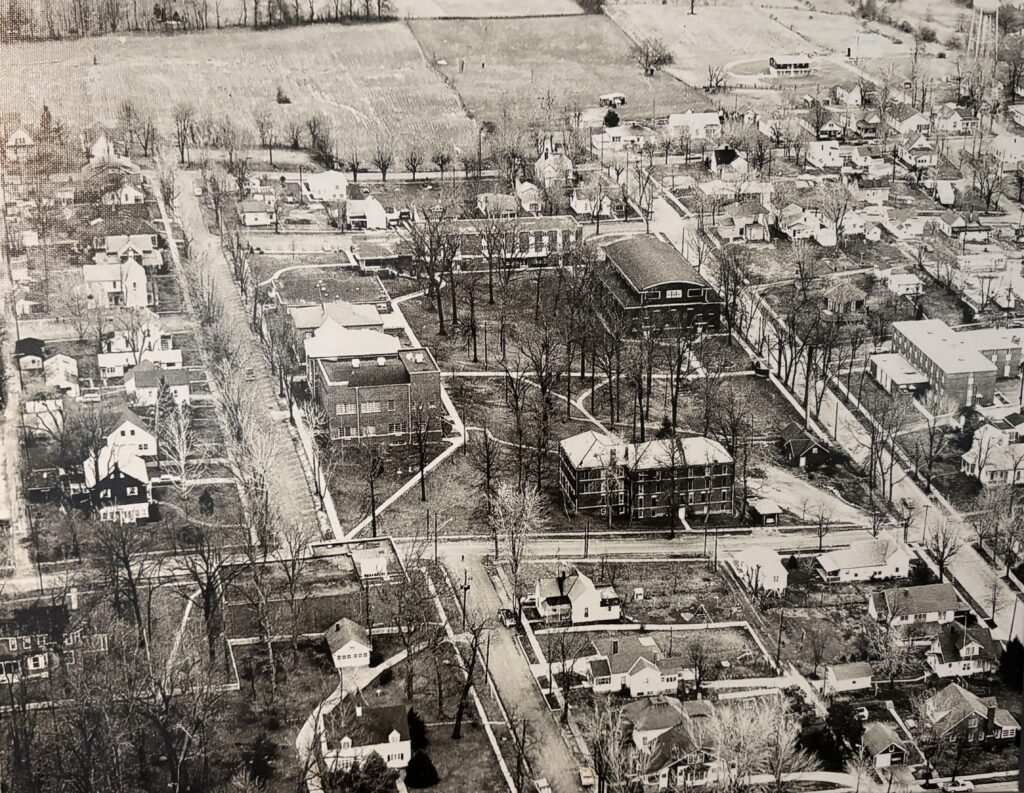
Arial photo of the old OCC campus, taken around the time I came on campus.
The O. C. Collegian, boldly declared in its first issue of the 1969 fall semester that it bore the responsibility of aiding, establishing, and maintaining “an atmosphere of free and responsible discussion and . . . intellectual exploration on our campus.” The Collegian, the article continued, would be published “with editorial freedom” in order that the school newspaper “might maintain its integrity of purpose as a vehicle for free inquiry and free expression in an academic community such as Oakland City College.” The article was a bombshell, a mini-Declaration of Independence.
Among the Collegian reporters at this time were a number of strong and intelligent personalities, aggressive gadflies, who believed it their responsibility to ask difficult questions and prod authority. Their attitudes and actions created a spirit of dissent, as well as a large dose of youthful idealism on the little conservative campus.
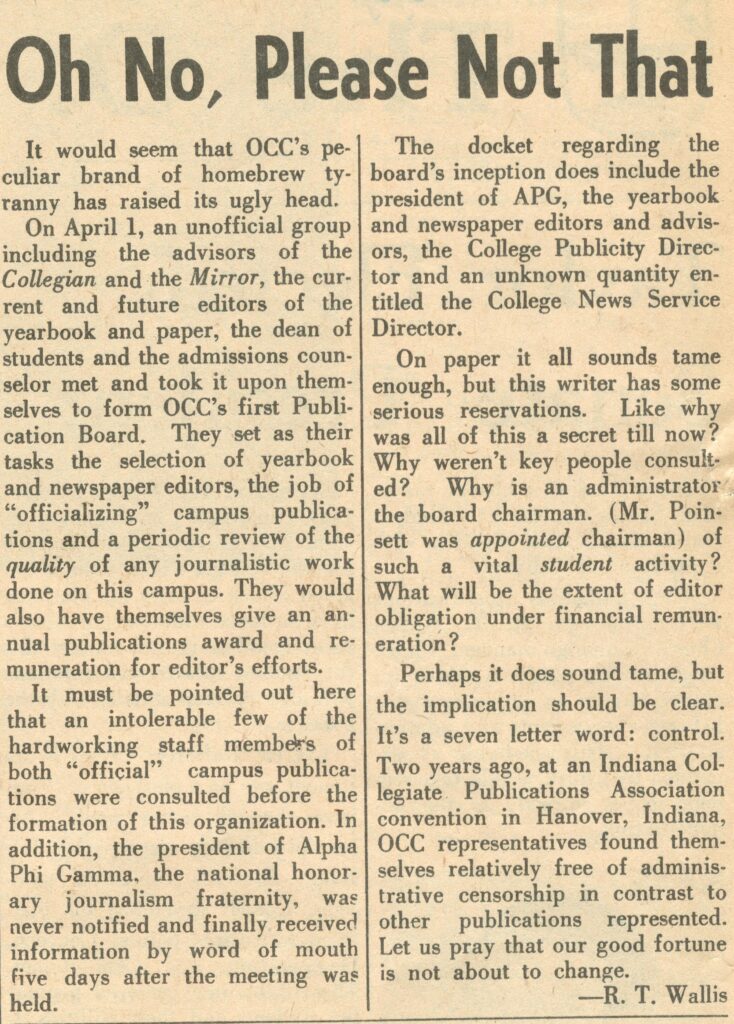
A blistering R. T. Wallis article in the OCC newspaper regarding new editorial rules
To counter this student aspect of student power, the school administration created a Publication Board which tried to oversee what the newspaper published. The faculty sponsor of the student newspaper, Judy Whitten, however, allowed her charges an amazing amount of leeway in what they wrote. Judy recalled, “I became the Collegian sponsor in the 1969-1970 school year, and the newspaper reflected, in a small way, what was going on in the country. We were a microcosm of the world. It was also a student newspaper, so I attempted to let it be that—student-oriented.” Judy Whitten’s beliefs and policies allowed for some interesting and important historical artifacts about the college to come into existence.
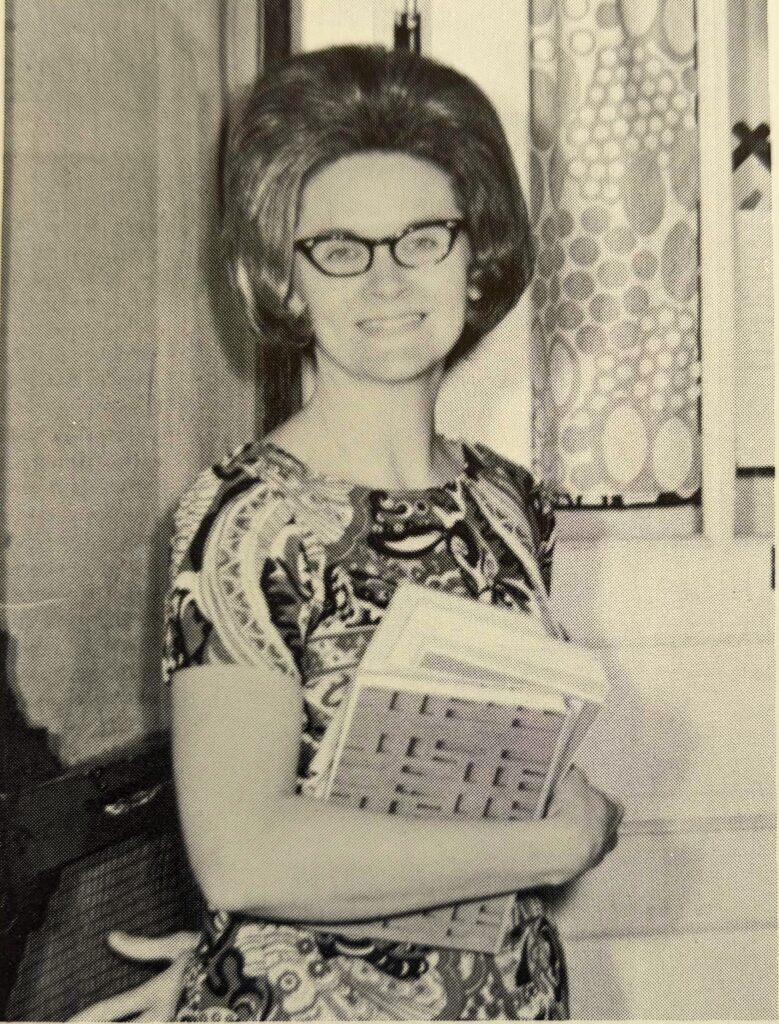
O C Collegian sponsor, Judy Whitten
So, it began. Issues of the Collegian in the early 1970s often ran several pages and contained a rich variety of articles regarding the many different aspects of the college’s daily life. Also embedded in these issues was a consistent stream of pieces which harped on student rights. Editorials, regular columns, letters to the editor, and other articles in the school paper indicated that many OCC students strongly desired to bring dancing on campus, to have more say in school decisions and in the quality of classroom instruction, to receive better food in the cafeteria, to have more freedom in the dorms, to live off campus, to have control over the discipline of fellow students, and to wear the latest fashions.
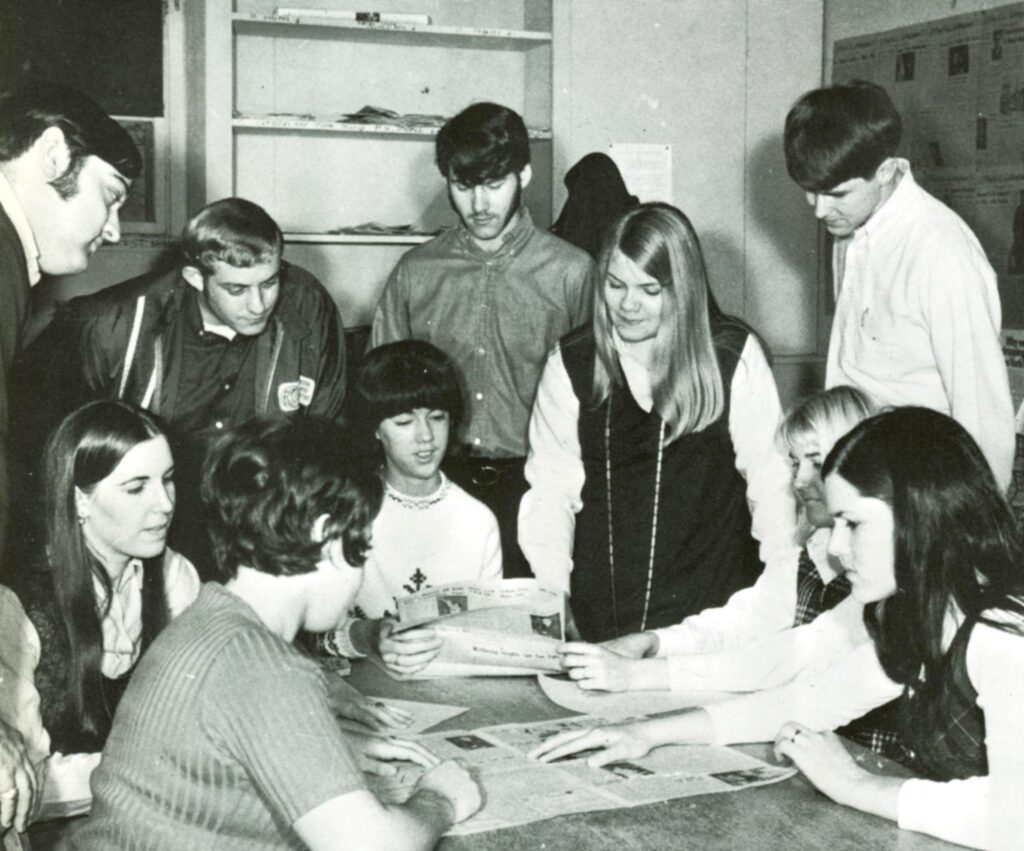
O C Collegian newspaper staff, 1969-1970
I was not a part of this aggressive, idealistic group, being far too fearful at the time to face the reality of my own personal struggles with what I had been taught about the world. Instead, I filled much of my time with reading books, involving myself with pseudo-intellectual conversations, and playing intramural basketball, the latter allowing me to still keep in touch with my high school glory days, a time when my life seemed much simpler. Secretly, however, as I hurried to find the latest copy of each new issue of the paper, I dreamed of being brave enough to wade into those exciting waters of dissent.
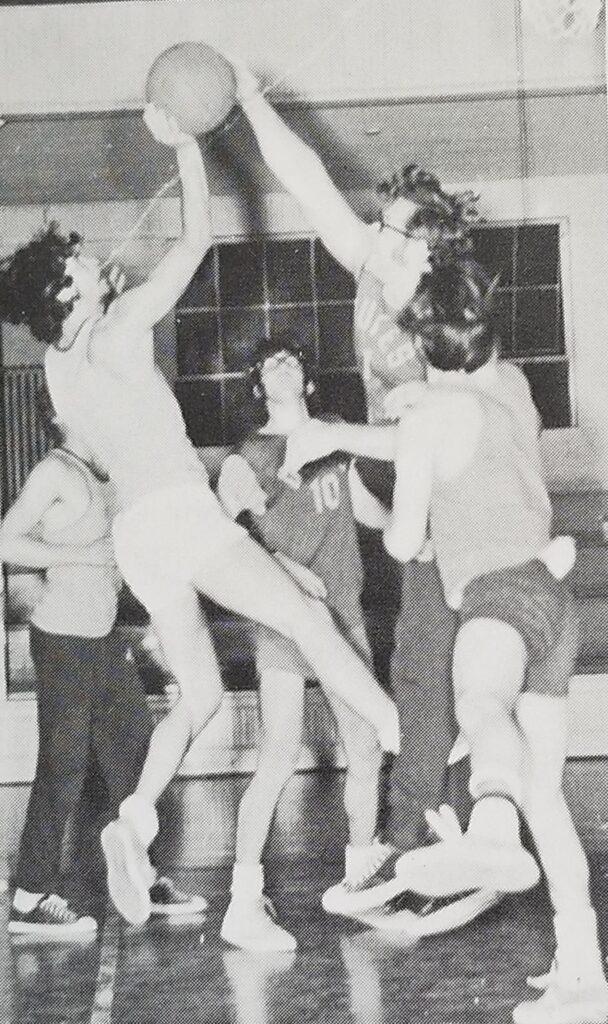
In 1969, I was more interested in blocking a shot than protesting
The school’s choice of a Founders’ Day speaker in the fall of 1969 suggests that leadership at the college was aware of the growing turmoil, and, on some level, wished to bring someone to the campus who would forcefully speak to the concerns of the day. Indiana’s U. S. Senator Vance Hartke, a local boy who made good and was one of the very first senators to come out against the war, spoke that year. His presence seemed to increase student interest in national and world events. Suddenly, I was hearing chatter among students on campus about the war and other issues of interest.
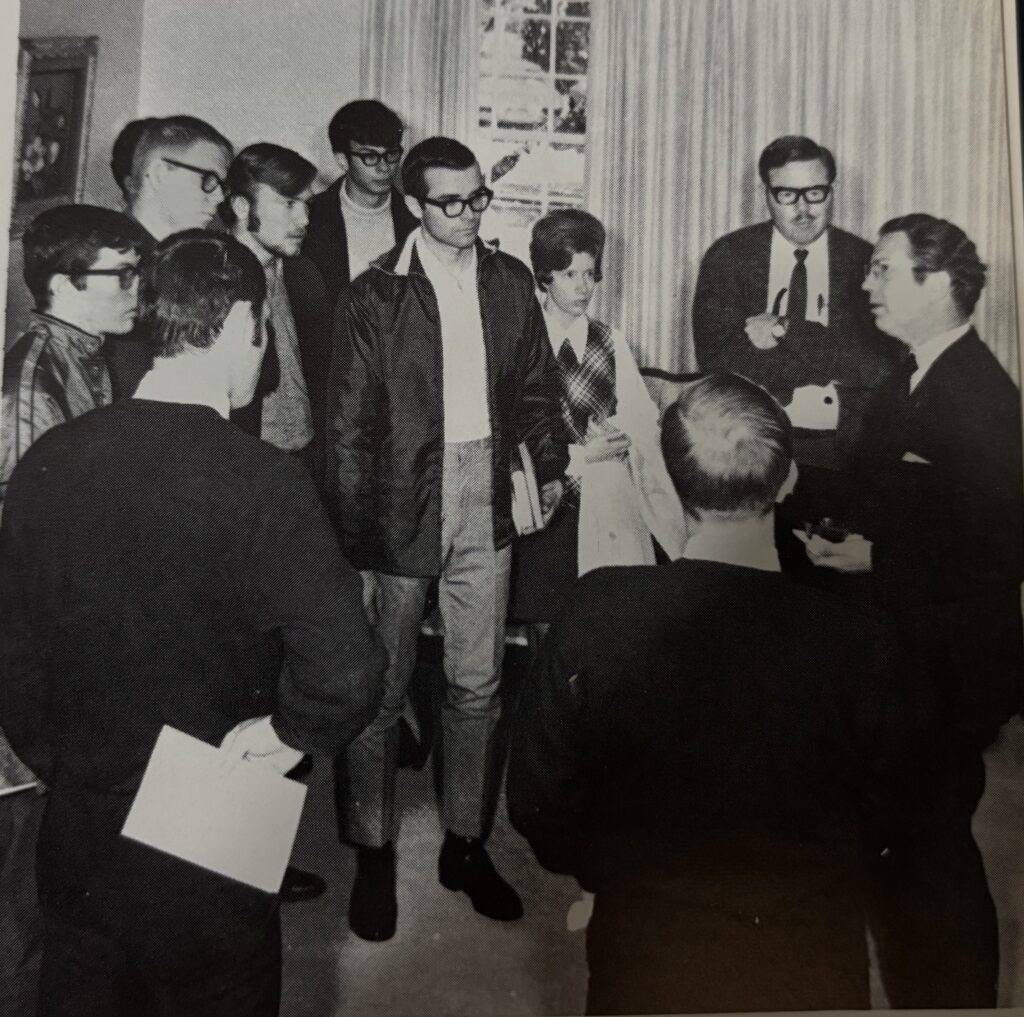
Anti-war Senator Vance Hartke, far right, talking with OCC students.
But there was one short time, early in the 1969-1970 school year, when the entire campus came together. That fall, in mid-November, college students marched fifteen miles from Oakland City to the county seat at Princeton to raise money for a new college financial campaign. One of the primary leaders was R. T. Wallis, the OCC newspaper gadfly. But the spirit of oneness died quickly, the strictness of some of the administrators lighting fires of discontent.
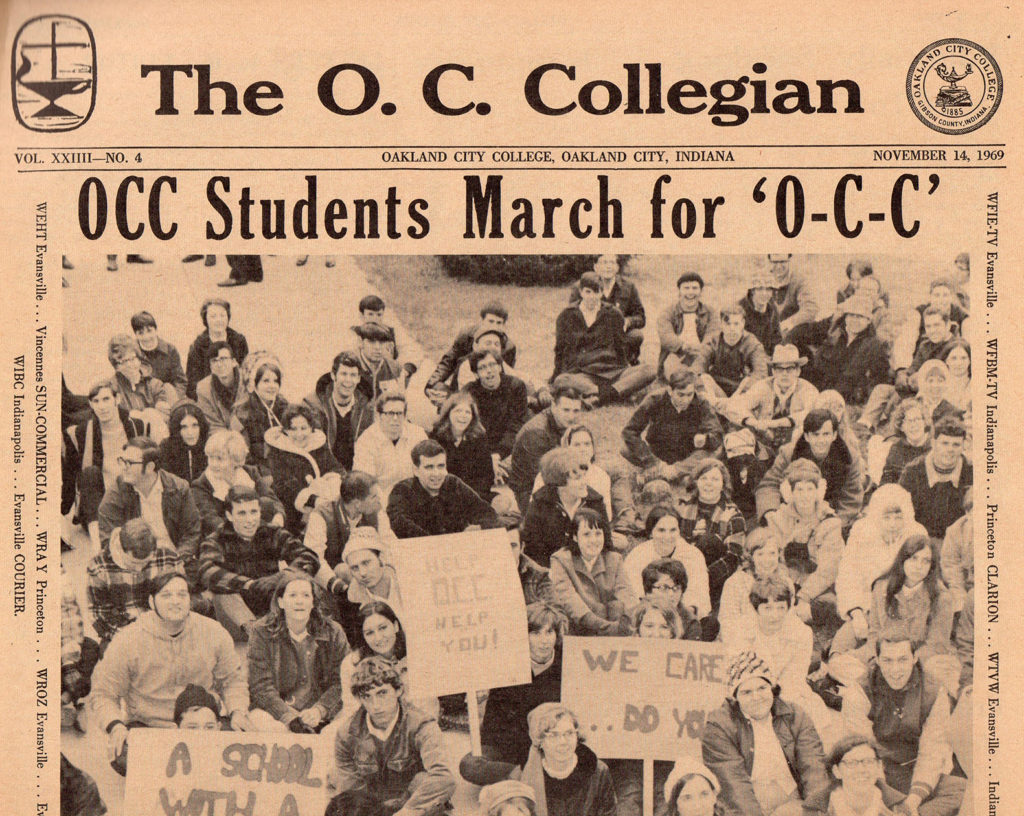
The campus united before the storm came
One example of the strictness on the OCC campus at the time can be seen in an early 1970 announcement in the Collegian. The college Dean issued a reminder regarding the school’s dress code. Authorities had, up to then, enforced the strict policy in only a haphazard manner, but now the Dean, perhaps sensing a change in the last few incoming freshman classes, decided to tighten the enforcement of the rules. “Women students are permitted to wear slacks during the winter season in the following situations: 1) When the preceding night’s temperature is 20 degrees or below. 2) When snow or ice is on the ground. This attire is permitted any place on campus including classrooms, dining hall, and the library.” A year later, the rules changed to allow OCC women to wear slacks, but only after chapel services. Meg Gardner Whittle, a student at the time, remembered how several OCC females marched in front of the President’s house to protest the policy. “We thought we were so progressive.”
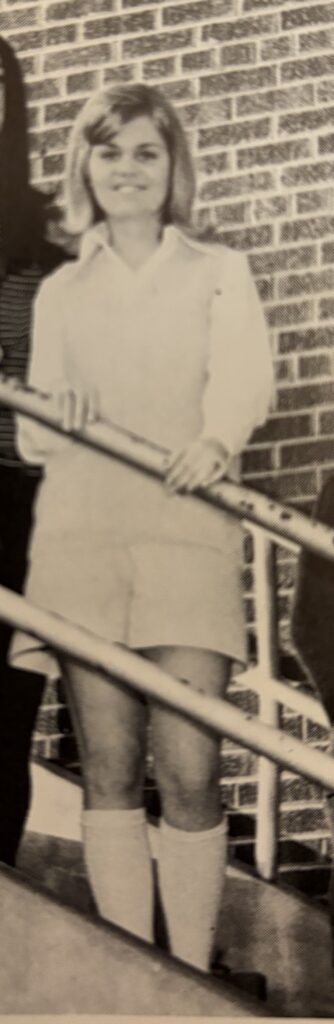
For all the concerns about girls wearing slacks on the OCC campus, skirts stayed short
The vigorous spirit of questioning rules such as this, and authority in general, is evident in a regular column written by Bill Menke, in the Collegian. In one piece, Menke encouraged OCC students to constantly confront faculty and administrators in order to create change. “Banding together in a mature adult way reminds the faculty member of his or her responsibility.” The article forcefully noted, “the channels [of protest] here are endless—petition, personal group confrontation, or personal confrontation with the [department] chairman. If these routes prove unsuccessful, arrange with the Dean of Academic Affairs a time when your group or spokesman can meet with him. Don’t forget the President and the Board of Trustees. You, however, cannot stop after one confrontation, you must keep trying. The quickest way to fail is to stop trying.”
That particular column received a sharp reply from an administrator, who quickly dashed off a letter to the Collegian. “One goes to college to get an education,” the letter declared in part, “not give one.” The initial article, and the ensuing response from the administrator, certainly brought forth a lively debate on campus.
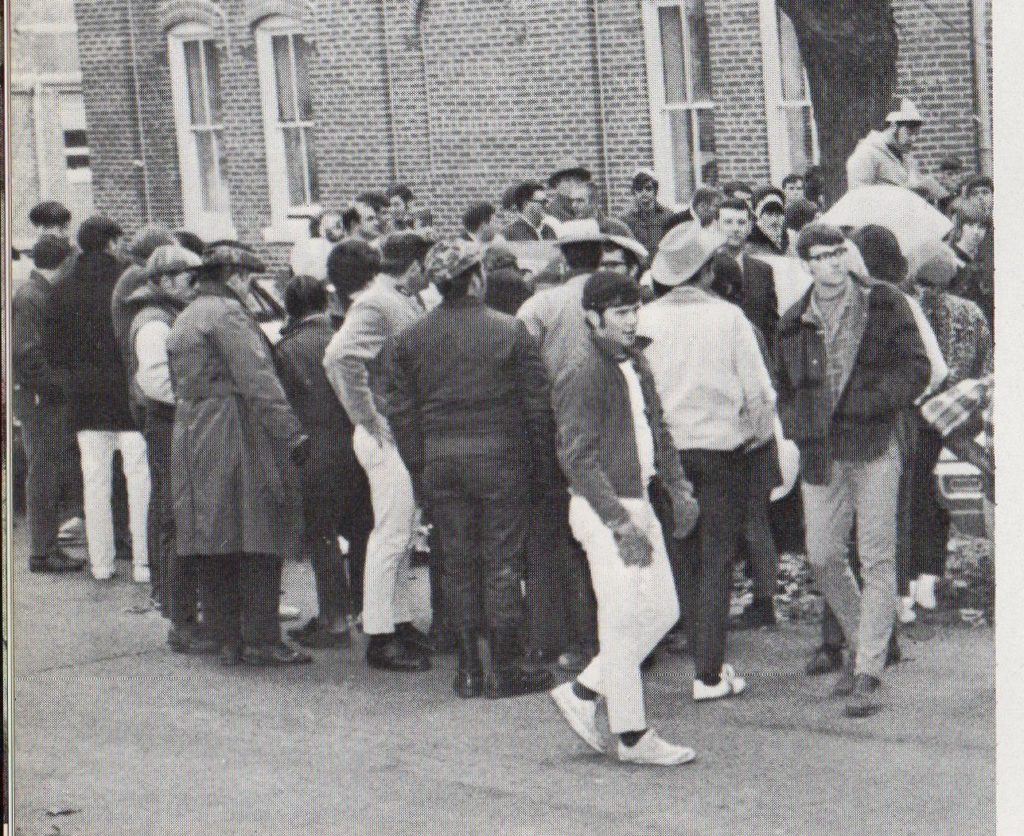
Me, far right, glasses, getting ready to march to Princeton in the fall of 1969
In late 1970, one particular student gripe came to a head. An aggressive group of upperclassmen called for a boycott of the school cafeteria, declaring, in a written statement to the Collegian, “Until now you couldn’t fight City Hall. But it has been proven that when a number of the students of Oakland City College band together, ‘city-hall’ will sit up and take notice. In our free and democratic society, industrial unions have proved the power of the STRIKE. . . . Therefore, we suggest that the students who are discontented with the present situation refuse to pay for or accept a meal ticket at registration time.”
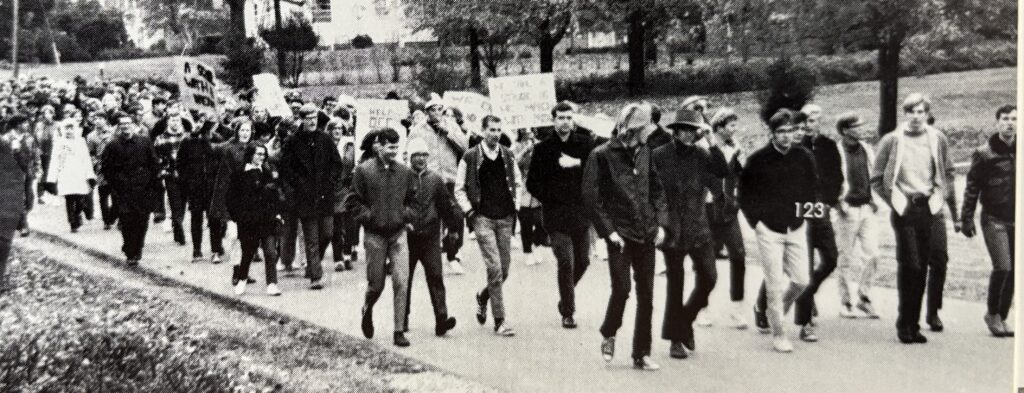
The many groups on campus, all marching for OCC
I understood this food complaint. I had been astounded by how many ways folks at the college cafeteria were able to prepare bologna, but I was not ready to go hungry over the issue. Fortunately, the problem was addressed, and the boycott never took place. And there was always the Oaks sandwich shop as an occasional alternative.
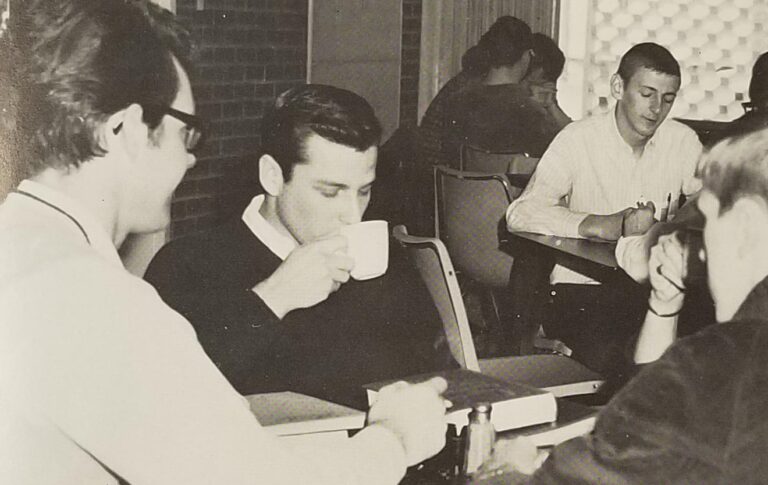
The Oaks was a great place to eat on campus.
Collegian articles suggest other rising concerns and the college administration sought to deal with increased student concerns and complaints by listening to student demands through so-called school “talk outs” But these talks were seen by many students as controlled by faculty and administration and that they never touched on day-to day problems at the school.
The Collegian kept hitting away. In one hot issue of the college paper, students complained openly about the school’s scholarship policy, lack of student activities, and dorm rules. Regarding the latter, Collegian writer R. T. Wallis noted, “Then there is the question of punishing dorm rules offenders. For this purpose, an enlightened group of students exist with the awesome title of ‘Dorm Council.’ Some say that for the most part members are elected; but you can’t believe anything you hear.”
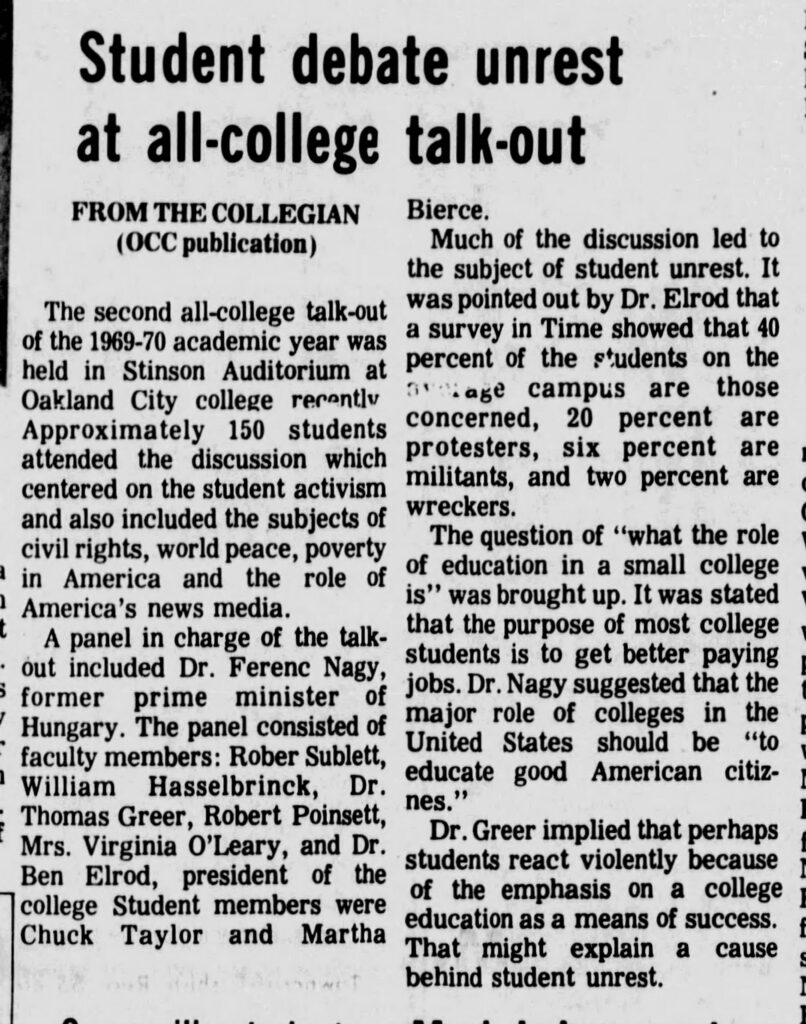
Talk-outs were considered by many OCC students as too controlled
Wallis was especially concerned with what he thought to be the unfair procedure for handling rules infractions. “When a dorm resident breaks a rule, no matter how trivial (keeping your tiny cubby-hole neat), the punishment invoked tends to run toward a classic psychological horror called ‘campusing.’ This ‘campusing’ may be likened to the solitary confinement practiced in the British navy during the eighteenth century. In its extreme form it resembles being locked in the tower of a medieval castle. Perhaps a properly constructed dungeon might serve the college’s needs in any future Women’s Residence Hall.”
Wallis also blasted what he perceived to be administrative hypocrisy. “The TRIBAL CUSTOMS, our consistently inconsistent rulebook, states with pious assurance that all punishments are designed to be ‘educational rather than punitive.’ I challenge that statement. ‘Campusing’ is an emotionally debilitating atrocity which (I predict) will someday cost the college quite a sum.”
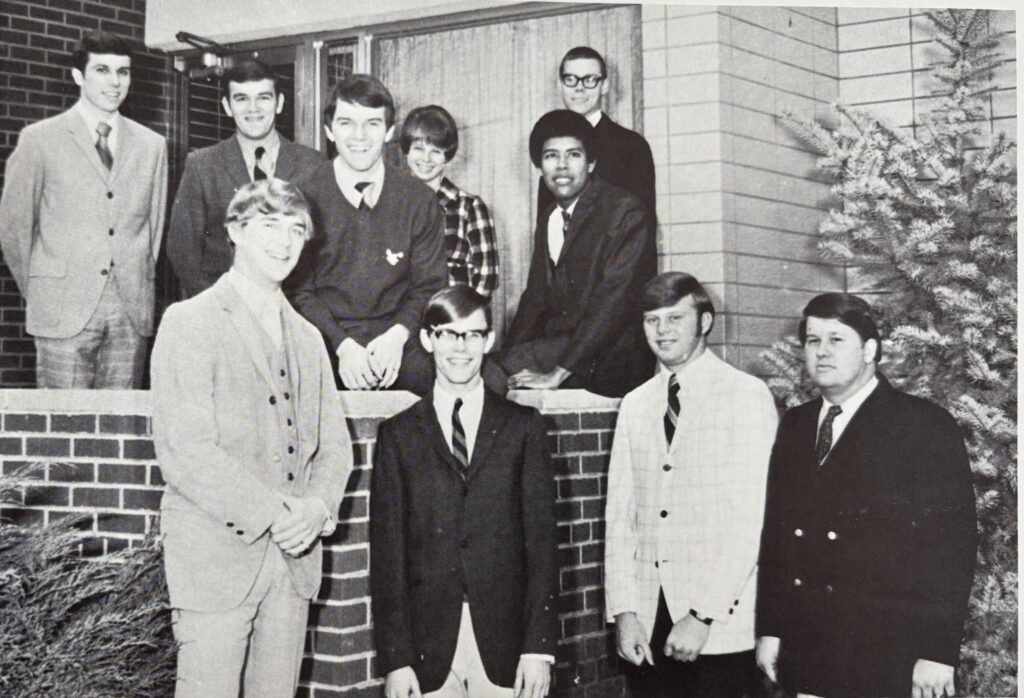
One of OCC’s “notorious” Dorm Councils
Wallis was not the only student complaining about strict dorm rules. Philip Ponder revealed in the college newspaper how “several Jordan Hall residents have been singled out by members of the dorm council over petty matters that hardly deserve the attention of a college or university dorm council.” (I believe one of those issues concerned how unkept my, and my roommate’s place of abode was.) Ponder was also concerned that dorm council members at OCC were chosen by school administrators, and not by students, arguing, “In most universities, the different administrators believe that college students are capable of choosing their own dorm council members.”
Perhaps taking their cue from students at larger universities, some OCC students attempted to band together to confront the college administration. In the early 1970s, Susan Baker informed the student body, through the pages of the Collegian, of an exciting alternative to the student talk outs, which many OCC students came to believe were too unyielding and school controlled. She wrote of a group of students who had created a new organization for school reform at OCC called CONCERN. “Though the group’s purpose is inherently expressed in the name itself, it is spelled out in full title “Committee Of Neglected Crusaders Energetically Reforming Now (which proves the members must have something on the ball just to remember all that!).”
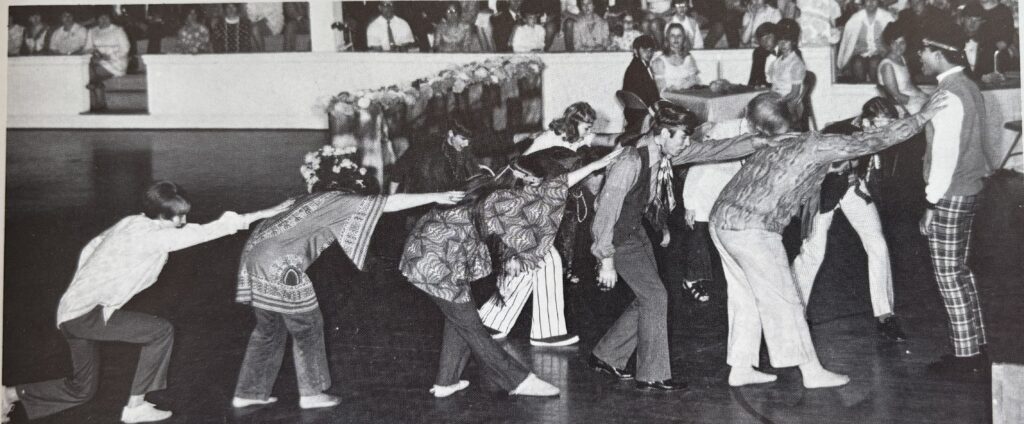
The dawning of the Age of Aquarius on the OCC campus, May Day Program, 1970
Another aggressive OCC person for students’ rights, Stan Cobb, who worked on the Collegian staff, lamented over another problem at the school. “In the time span of one week several humiliating events have occurred on OCC’s campus under the super direction of our campus lawmen. One night the Campus Cops followed some students who were only driving around campus, and somehow the student driver found himself right behind the Campus Police only to find a lengthy five-cell flashlight beaming at his face. One should consider such an act dangerous to the drivers of both cars and unlawful as well.” Cobb went on to assert that, “countless students have complained about the poor timing of our Campus Police. We adults, however, should realize that a female driving by Dearing Hall after dark could not possibly stop and carry on a conversation with male residents, for that, as one knows, is a ‘no-no.’ And for naughty couples that would prefer occasional privacy, forget it. The Campus Cop knows every nook and cranny on our campus. Arrangements could be made, however, for couples who would like to ‘double’ with a pair of police. Our maturity must surely turn into pumpkins at 10:30 p.m.”
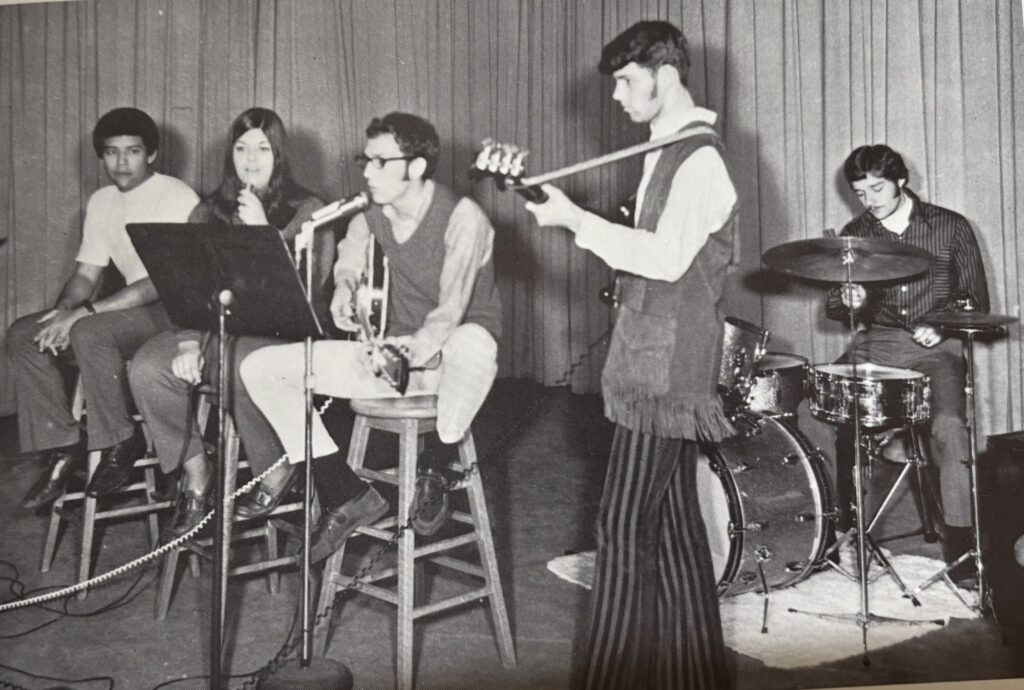
Stan Cobb, standing with guitar, often voiced strong student concerns in the Collegian.
In late 1970, Susan Baker again complained in the Collegian about the non-dancing rule and several other issues that angered students. Baker, however, saw hope for change emerging from several recent aggressive actions taken by students. Her comments are both naive and refreshing. “The scent of rebellion is in the air. . . . If we are to be accused of immaturity, we should point out that by and large, we are treated like children—so what can you expect? Together we could finish sweeping the cobwebs out of this antiquated institution; and if we have to disturb a little peace to do it, let the dust fly!”
OCC students had also long bemoaned the lack of a student union building—a structure administrators had promised for some time would soon be constructed. By early 1971, OCC student power had achieved one goal of sorts: the college purchased an older house at the edge of the campus to be used as a makeshift student union. Susan Baker wrote to the student body, declaring, “Okay, you’ve got it. That’s right and if you’re willing to make it work, Sherman House can be the end to the boredom problem that plagues this campus. How does it sound? Your place. To play your kind of music; play cards, chess, etc.; study together; hold meetings; just socialize. And it’s waiting in that big grey house on the corner.”
Students, however, were not completely satisfied even after being given the use of Sherman House. Diane Hampton, one of the editors of the Collegian during this era, sarcastically noted, “It has been rumored that a student union building is somewhere in the offing but its sorta like the second coming of Christ—no one seems to know just when. But those of us who believe in the second coming also believe in that mysterious thing called a student union building, and it will come, provided the Lord doesn’t come first.” Hampton was not far from wrong in her tongue-in-cheek observation. A true student center would not appear until the next century.
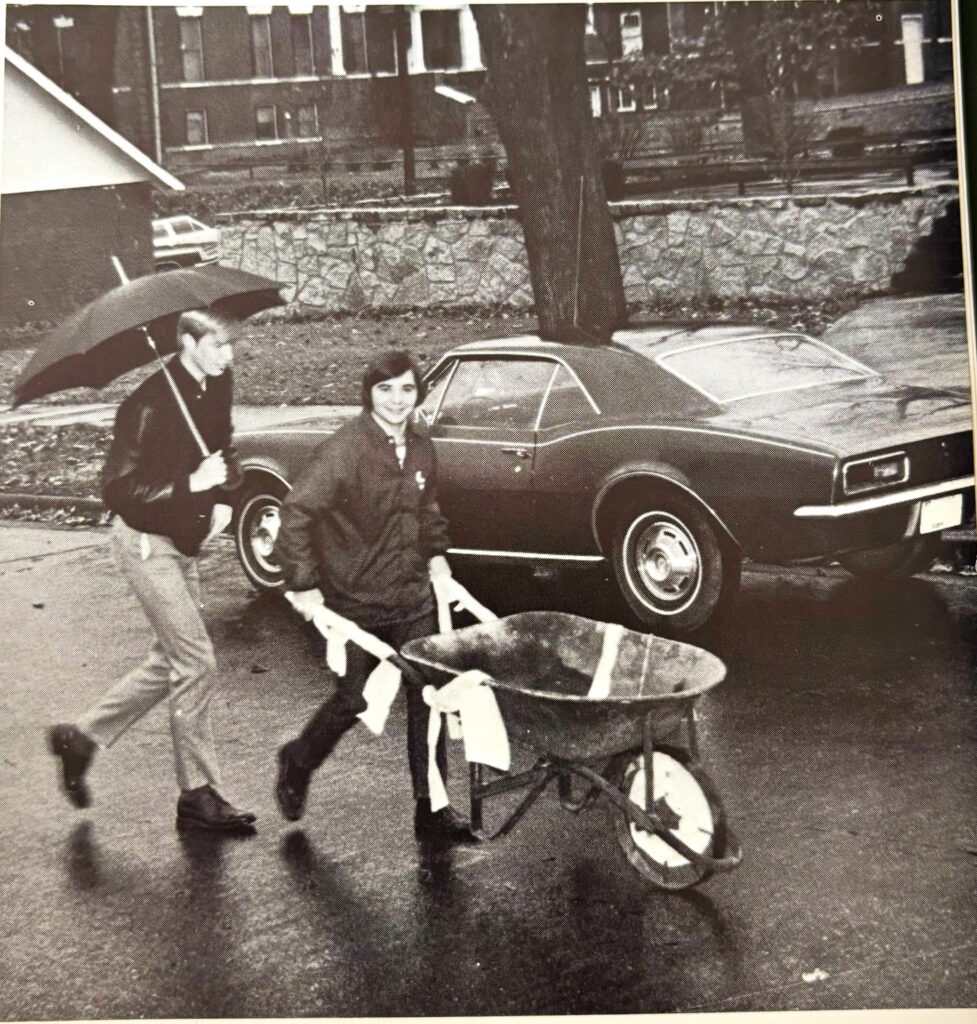
Students weren’t always complaining. Bruce Sebert and Joe Betz- Best Homecoming float ever!
The unrest and tension of that time at OCC is also evident in the sudden appearance of a new underground campus newspaper called Daylight. Collegian writer Linda Leslie spoke to the existence of the rival paper in the form of an interesting Collegian editorial. “Something considered radical by most has struck the small conservative campus of Oakland City College. I am referring to the recently published underground newspaper. The newspaper called Daylight shocked most of the faculty and administration, but the majority of students on campus agreed with one person’s comment placed on the bulletin board, ‘Truer words were never spoken.’ Journalistically,” Leslie judged, “Daylight was an absolute wreck. The grammar probably turned more people against the paper than anything else. The spelling was annoying.” Of more importance, Leslie asserted, “making unnecessary personal slams is not a very mature way of stating an idea. Also, ‘four-letter’ words may be prevalent in today’s speech and literature, but they do not belong in journalism.” Leslie added, however, that she “found the two major ideas presented by the paper far from radical. Weekly open visitation and later dorm hours are two things most students on this Campus have wanted for a long time. Later dorm hours were actually almost achieved, but we know what happened there, don’t we?”
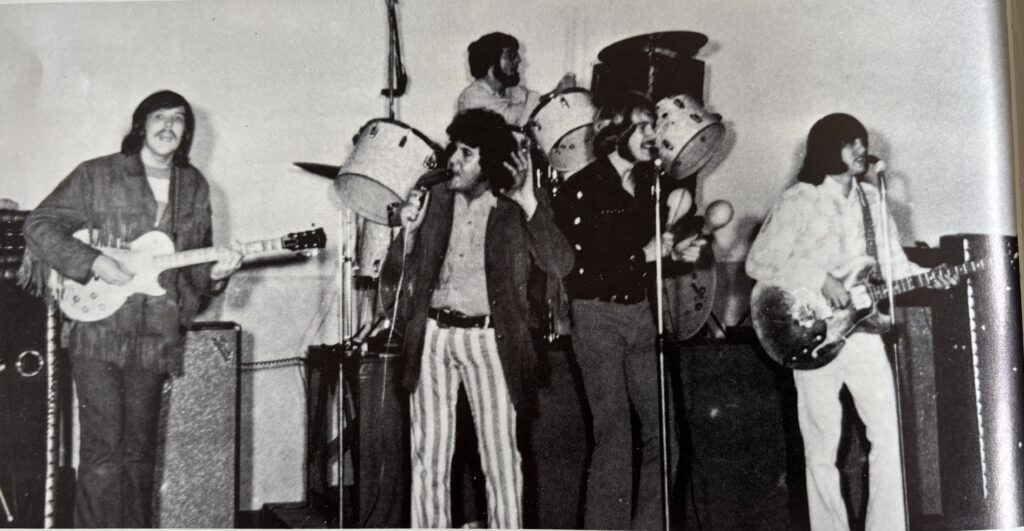
Sometimes complaining helped- a rock group of the day finally playing at OCC.
In the same Collegian issue, another student bitterly complained of ill treatment he believed he had received from campus authorities, declaring, “The OCC ‘Gestapo’ has struck again.” The writer then went on to tell of a student who had moved off campus. “Within days after he had moved in, he was forcefully evicted. At 9 a.m. the door to his humble abode was kicked in, and he found himself being [told] to move back to the dorm or face suspension from OCC. And it wasn’t the landlady doing the threatening either. . . .I could have hunted up the editors of Daylight to print my reaction to this incident, but I wanted to endorse my feelings with my signature. However, I don’t blame those editors for their choice of anonymity. . . . But I hope they and others will find voice for their thoughts in the legitimate press. Then perhaps, the truth would make us free.” Later that year, the same student bemoaned of the lack of student government power. “It is time we realized that other campuses elect Student Governments to see that the students have some say in the way the school is run. The most monumental problem our Student Senate faces is the choice of what group will play at the Homecoming Concert. We don’t have a Student Government; we have a Treasury Department.”
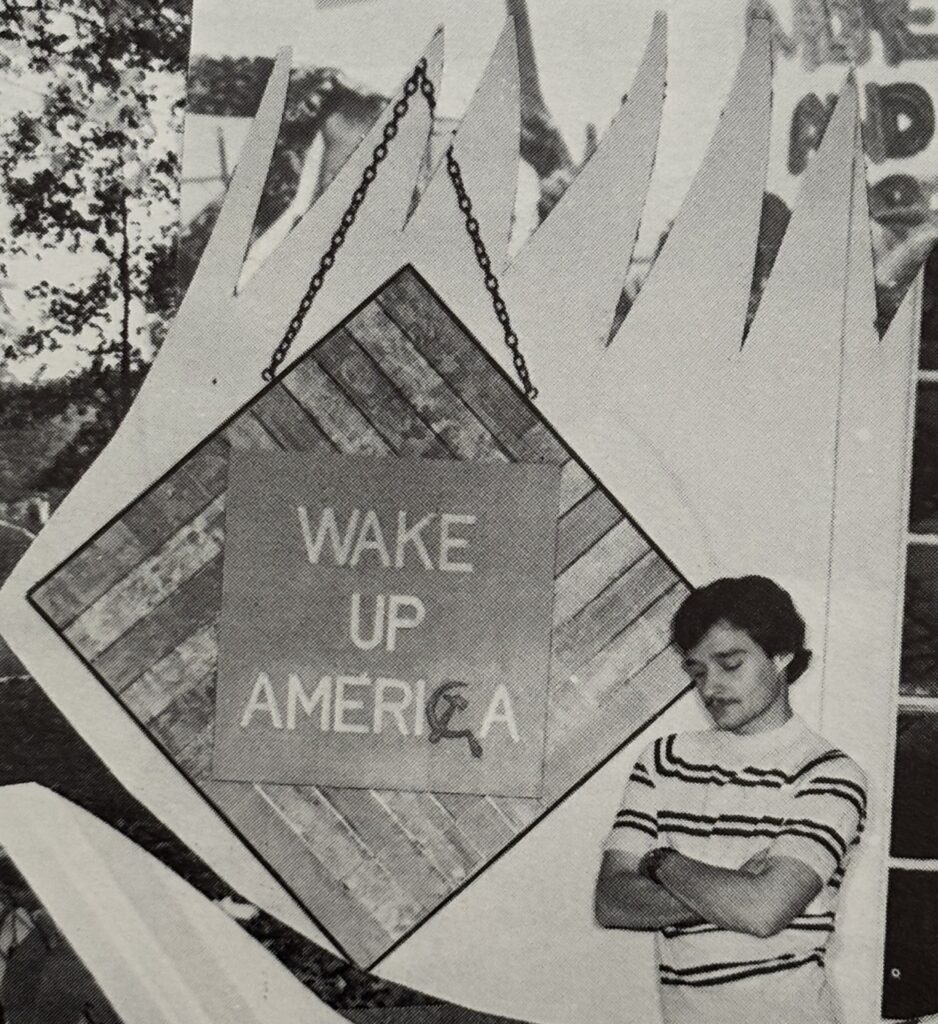
One of the many photos floating around campus that warned against authority.
_______________
In the midst of all this verbal turmoil, a new college president, Dr. Bernard Loposer, came to Oakland City from the University of Alabama Huntsville in the fall of 1971. Relatively young, kind, energetic, and quick witted, Dr. Loposer soon captured the approval of OCC students. Loposer stated his pro-student philosophy in an open letter to the “College Family.” At the onset, he noted, “The touchstone of uniqueness here at Oakland City College is rooted in our belief that the most important element in education must remain the people who are engaged in the pursuit of truth.” He then went on to proclaim the college “the people place.” His letter hit a deep chord with many idealistic students.
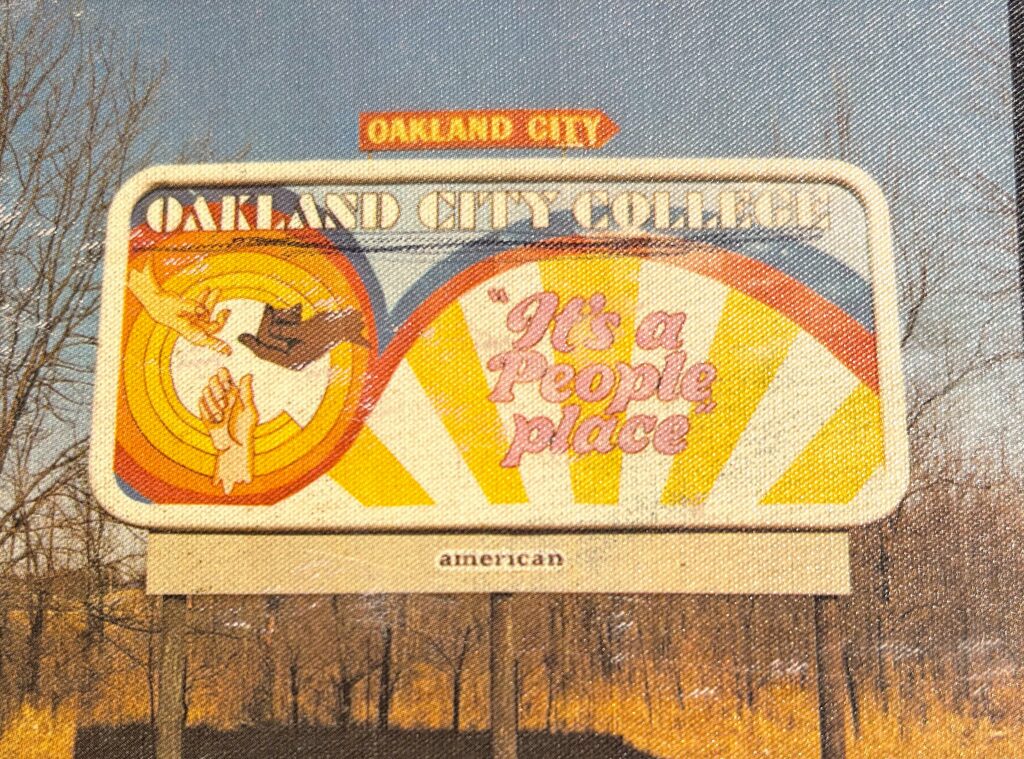
A billboard just outside of Oakland City announcing OCC as a “People Place.”
An odd show of respect for the new president came early in his administration when several students, who resided on the third floor of Jordan Hall, kidnapped Loposer from the Presidents House on campus on his birthday and carried him up to the third floor for that floor’s customary birthday dunking in the dorm showers. Joe Betz, Carl Runyon, John “Hoss” Browder, Kevin Eskew, myself, and maybe some others I’d forgotten, carried out the cheeky deed one night, throwing a blanket over Dr. Loposer when he answered the door and placing him in someone’s car for the quick ride to Jordan Hall. We threw our new president, clothes and all, into the showers. Fortunately, Dr. Loposer understood the daunting experience as a sign he had gained the initial respect of even the most daring of OCC students.
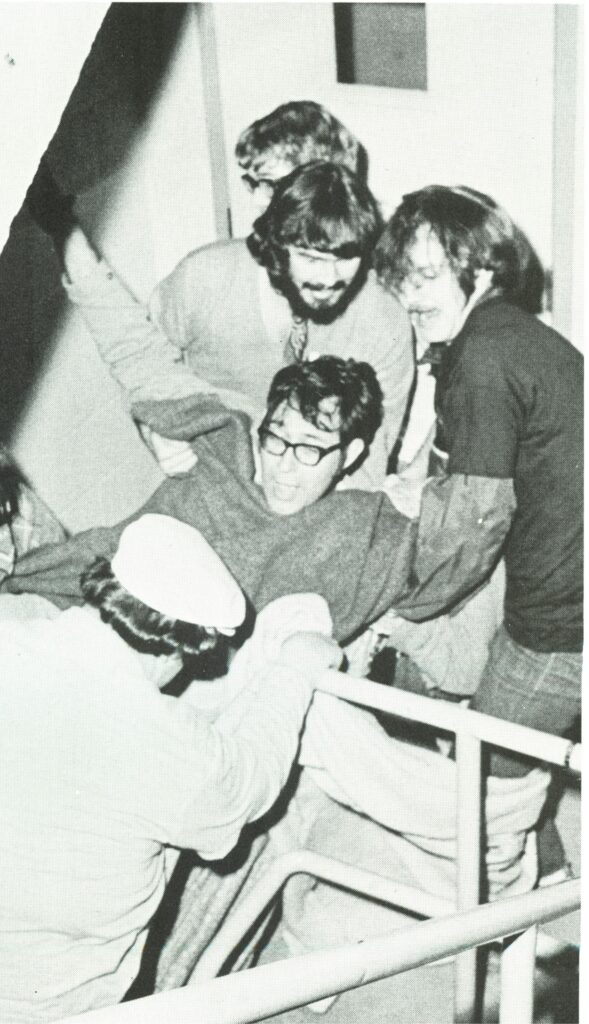
Our new president on the way to the Jordan Hall showers.
Loposer solidified his popularity by going out of his way to “rap” with students, often seeking out the more aggressive leaders and listening to their ideas. Under Loposer’s influence, an increase in dorm “rap” sessions occurred. The spirit of student empowerment and responsibility Dr. Loposer attempted to cultivate would soon help turn student complaints toward more positive activities. One positive result, for example, was a plan to have a student march to Evansville, to raise money for the college and to give the school some positive publicity. In his Collegian column, “Under the Lid,” Jim King related the background story to this important march. “One night Tom Malin, Bill Byrd, Bill Menke, John Redpath, Kelly Whitsitt, and John (Hoss) Browder were engaged in one of these rap sessions, and the topic they were discussing was, if I may use a much worn-out term, campus apathy. Ideas were presented and discussed and then someone mentioned a march to Evansville. Later the idea spread and Margie Schneider, Nancy Brown, Linda Waltz, Kathy Garner, and Linda (Gunga) Dorrel joined the movement, and now well you can see the results all over campus. . . . The main point of this column,” wrote King, “is that the march was thought of, planned, initiated, worked on and promoted by students.”
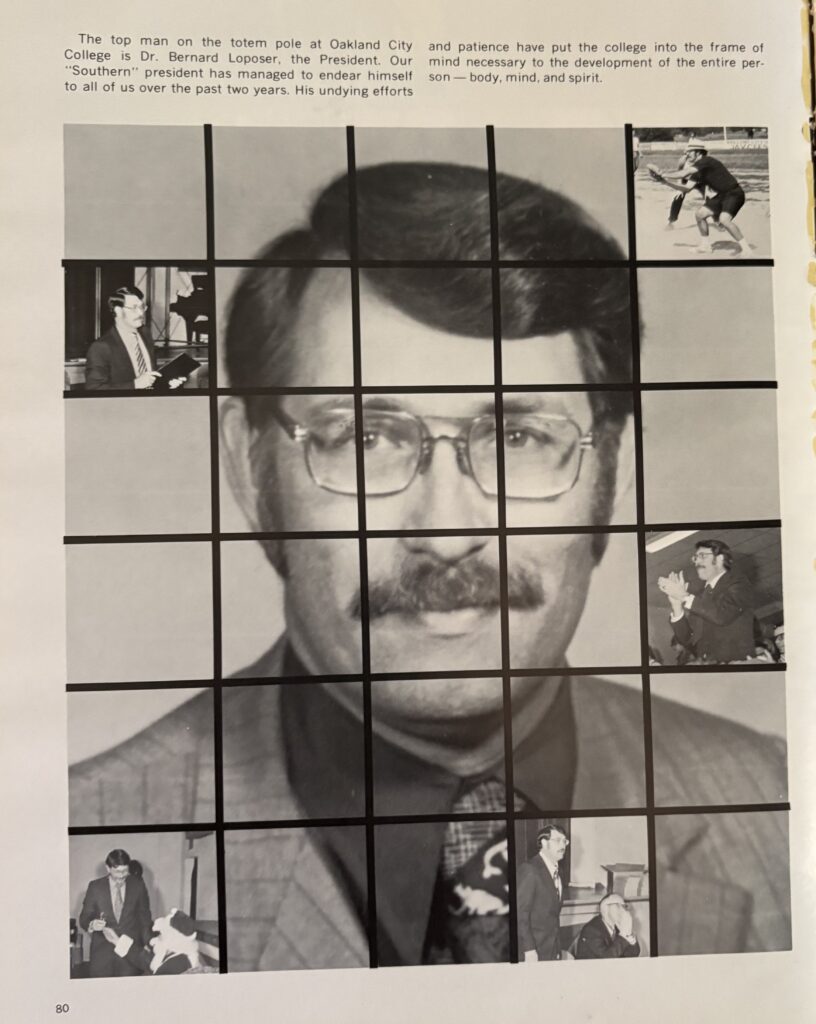
Popular Bernie Loposer got a full page in the 1973 OCC yearbook. Later, his popularity would take a hit.
The popular college president moved quickly to further connect the administration to students by an especially stunning move—initiating a Student Judiciary Court. This body was given more unheard-of power over student disciplinary actions than OCC student governments of past years and perhaps represented the pinnacle of student empowerment at OCC. The Collegian reported the exciting news, explaining, “The Judiciary Court will settle disputes between organizations and act upon cases referred to it by the students. The court will also act upon serious offenses brought it by the dormitory council, Dean of Students, Student Senate president and/or the Judiciary Court Chairman. The court will try the offender and recommend proper action to the Dean of Students. The Dean of Students will then enforce the decision of the court. Any tried offender may petition for recall. The court will supervise all campus elections and review decisions made by the Senate.”
The court was a heady change from the more traditional position of previous administrations. Dr. Virginia O’Leary, an English professor at OCC, and a lawyer, became very involved in this endeavor, adding her voice and expertise to the call for more student involvement and power.
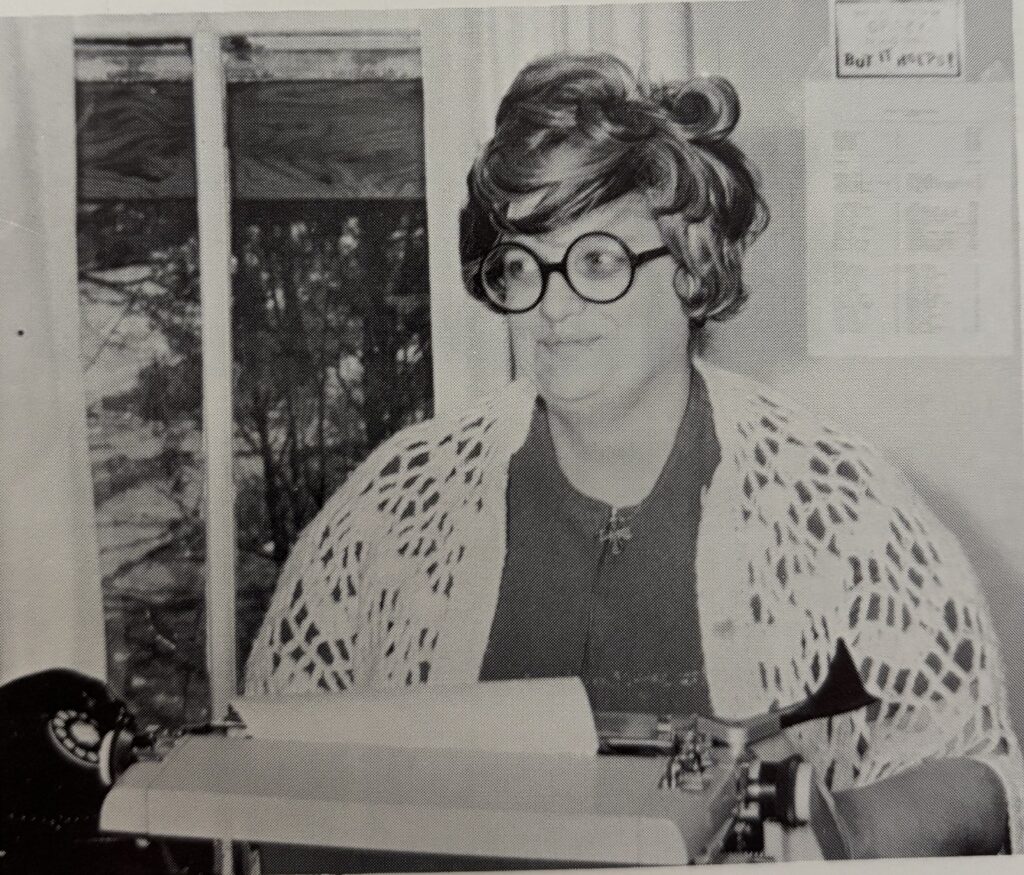
Virginia O’Leary, an OCC English professor, was a stanch supporter of student power.
Members of the court quickly acted to make the entire student body aware of this new aspect of student empowerment on campus. Another Collegian article reported that “the Judiciary Court of Oakland City College is part of the constitutional reform in student government effected in the past year. The creation of the Court places all matters of student discipline within the jurisdiction of a court composed entirely of students. How effective the Court depends entirely on how well the students use the Court.” Members of the first board were Grady Jones, Keith Clark, Carl Runyon, Margie Schneider, Steve Benjamin, Tom Malin, Bill Byrd, Mrs. Virginia O’Leary (sponsor), Steve Smith, and Ruth Blemker. Later, Bill Bryd, Cindy Tuttle, Pam Bass, Steve Dorsett, John Wayne Smith, and Chuck Strunk would be added to the court.
_______________
The sense of student empowerment during Barnard Loposer’s administration was not to last. In late 1972, President Loposer carried out a very unpopular act when he dismissed two students without going through the recently created Student Judicial Board. The Board, for their part, did not necessarily disagree with the dismissals, but with the fact that the two students had not been given the due process promised by President Loposer. Dr. Loposer, however, would not back down from his stand, and many students ended up feeling betrayed.
In a tense piece in the Collegian, Student Judiciary Board members asserted, “Many questions have been raised due to the fact that two students were expelled in October by Dr. Bernard A. Loposer, president of the College, without consultation with or consent by the Student Judicial Board. Some basic understandings were sought; the results of that meeting now need to be brought to the attention of the student body as a whole.” The article then pointed out that “The Judicial Board, in opposition again to the decision of the President, recognizes that Dr. Loposer has the authority to pursue the methods as stated in the meeting, but sincerely believes that the Board is capable of hearing all matters of student discipline unless the cases are of an extreme critical nature. If such situations develop, they should be referred to the civil courts.”
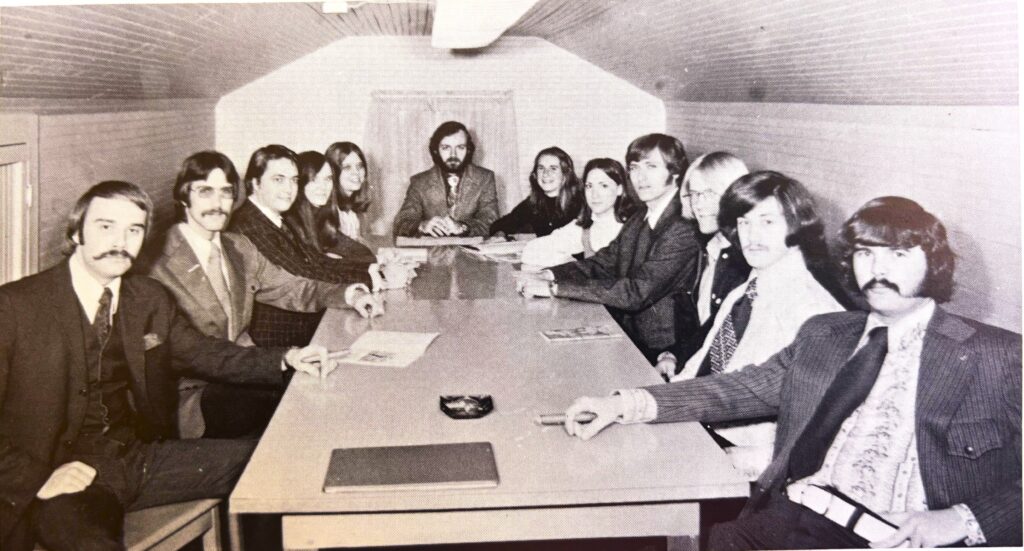
The Oakland City College Judicial Board, seen here, and OCC President Bernie Loposer sometimes clashed.
The article clearly presented President Loposer’s arguments as well. “Dr. Loposer was very clear in his assertion that the orderly operation of the College has to be maintained for the very survival of the College. The school paper further stated that the responsibility for the governing of the affairs of the student body must be assumed by students as a whole if the current philosophy is to function properly. If there is a breakdown in the procedures as they have been established in line with the existing philosophies, then a vacuum will be created within the academic community. In the face of such a refusal by the student body to assume these responsibilities, the administration will have no choice but to act in a manner which is considered to be in the best interest of the student body as a whole and of the college as an educational entity.”
President Loposer quickly moved to carry out damage control by reasserting his closeness to students’ concerns. In a lengthy article in the school paper the college president explained, “By entering an institution of higher education, [the] students must admit that [they] are ignorant and in need of deepening [their] understanding of the world around [them] through the pursuit of truth. However, [students] soon get caught in the great hang-up of the system. This in turn fosters the feeling that [they] are studying for tests and meeting requirements instead of really learning those things that are more relevant to the truth. What we need to do is to provide opportunities for students to learn and enjoy learning. We need an approach which would be conducive to the elimination of the basic ignorance that inhibits our knowing higher truths.”
Loposer then shared his own vision of how needed changes might occur on campus. “All revolutions must begin in a small way. They must begin with the change within the individual. I am not referring to the establishing of rap sessions. All rap sessions seem to do is blow off steam to somebody who wants to gripe. Rather, I would suggest the word ‘revolutionary’ or the ‘inner change’ as descriptive of this approach. Thus, I submit this in an open letter to you as students to think on these things and if there be any merit, let the spontaneity of the quest of truth move us to do those things that will lead to a deeper growth intellectually and a broader approach to the society that ultimately will receive us as it looks to us for leadership.”
Dr. Loposer’s words, published in the Collegian, came across to many idealistic students as too abstract. Toward the end of President Loposer’s tenure, some students pounded away at the vulnerable president and the rest of the college administration. Argued one student in a Collegian column, “The students have lost what faith there was in the administration. And I boldly state that, deep within, the administration has lost the faith they once had in themselves. The faculty is relentlessly attempting to stand on dry ground only to find themselves sinking fast in dissatisfaction along with the students.” More recently, Carl Runyon, an initial member on the judiciary board, recalled his disillusionment with the long-ago student dismissal incident. “I know Dr. Loposer felt strongly that he must act quickly and decisively, but the entire experience was extremely disappointing for me. For a brief time, I though OCC might become a true Christian liberal arts school, one where student governance was designed to make students responsible for their actions and thus had the potential to teach students to be spiritually and morally sound.”
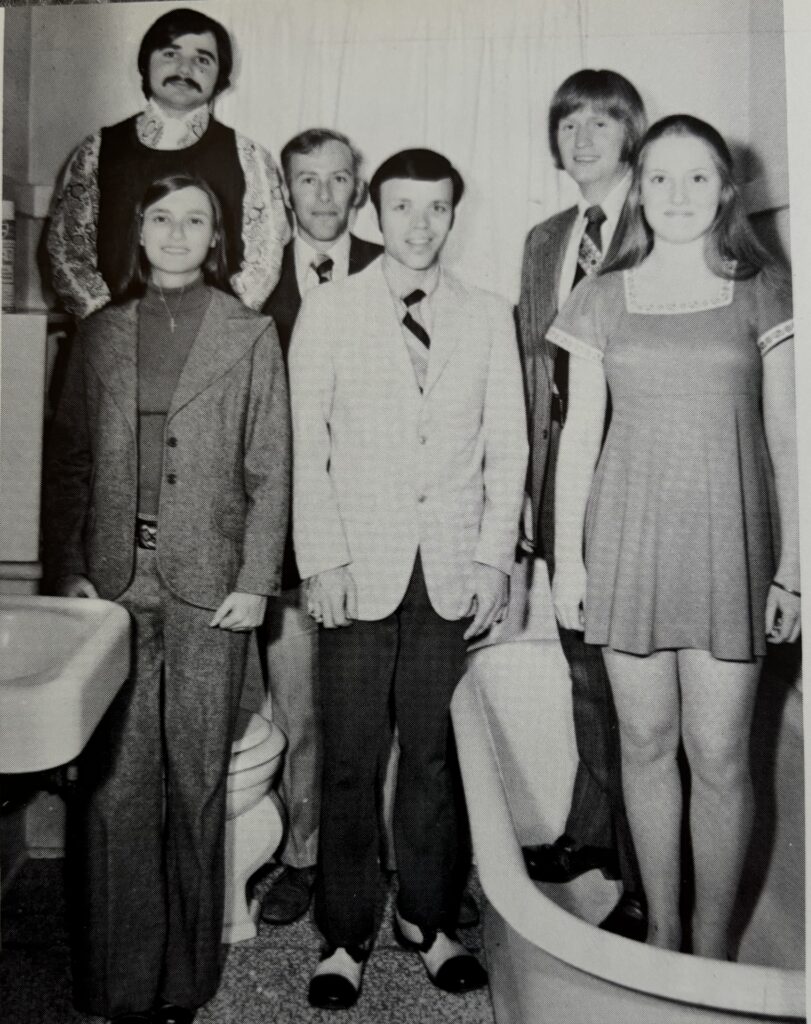
The OCC Student Union Board, another victory for student voices.
In truth, President Loposer struggled with complex problems of which the student body remained completely unaware. He had inherited the complicated financial troubles the college had developed prior to his term and which, under his leadership, came to a climax in 1973. The Collegian duly noted that these difficult events, along with some personal issues, caused Dr. Loposer to abruptly turn in his resignation at the end of the 1973 school year. His leaving heralded the end of an era at the college.
By 1974, colleges and universities across the nation were in trouble as enrollment dropped with the end of the Vietnam War, leaving many with huge debts from over expansion. Oakland City College came to the brink of closing before new leadership helped begin the long road back to prosperity. But the ensuing near collapse of the school in 1974, and the long duration of re-establishing OCC on a solid financial footing, did much to blunt the kind of student-empowerment-seeking culture which existed at the school in the late 1960s and early 1970s. Enrollment dropped drastically by 1974 and stayed low for over a decade. Given this reality, perhaps many students were more willing to sacrifice arguable student rights to keep the doors to the college open. Perhaps too, students changed over time as well, becoming more passive regarding social issues and issues of authority.
_______________
As I’ve grown older, I’ve come to realize how youthful and naïve some of the ideas of OCC students were back during my time there. Also, I’ve grown wise enough to understand that what many students perceived as unfair policies on the part of conservative minded administrators were most always offered in good faith and often based on information unknown to students. I certainly wish to thank the people, however, who served at the college in my time as a student there, people such as Judy Whitten, Virginia O’Leary, William Hasselbrink, Tom Greer, Roger Sublett, Bernie Loposer, and so many others, who believed college students, given guidance, could, with the administration, tackle many of the school’s problems.
It was a wonderful, messy, and sometimes scary lesson in democracy.
Biographical Notes
Information and photos for this work were primarily gleaned from issues of the Oakland City College student newspaper, the OC Collegian and from the school’s yearbook, the Mirror. A fuller story of the college can also be found in my book Enter to Learn, Go Forth to Serve: The Oakland City University Story 1950-2002, Stinson Press, 2002. Also, the author wishes to thank Mary Elaine Gardner (Meg) Whittle, Carl Runyon, Scott Slater and Judy Whitten for sharing some of their memories of OCC during the late 1960s and early 1970s.