Almost any Indiana high school basketball fan can name loads of great coaches, players, and teams from the distant past, but few if any referees’ names are likely to pop up. Yet a high school basketball contest could hardly take place without referees. Fortunately, a deep dive into old Indiana newspapers sheds important understanding on an early pioneer in Indiana basketball, a referee who became the initial model for what a high school official should be before, during, and after a basketball contest. His name was Birch Bayh, and his story brings many golden nuggets of the state’s rich high school basketball history to light.
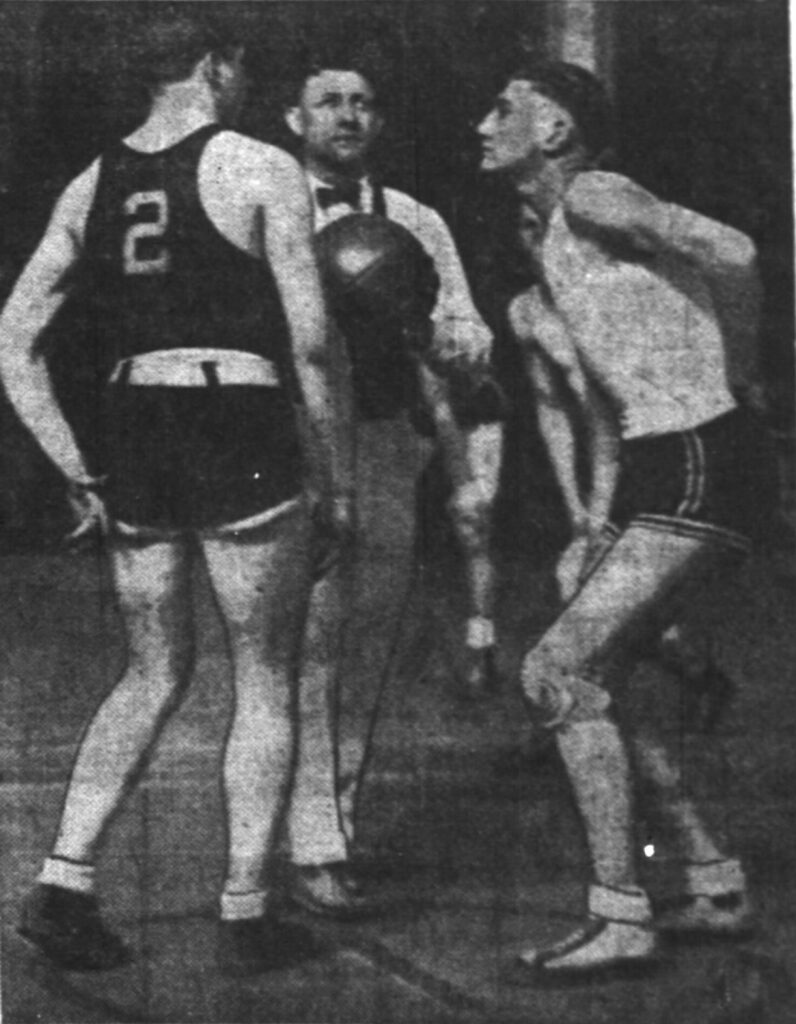
A good referee is made and not born, and Bayh was no exception.
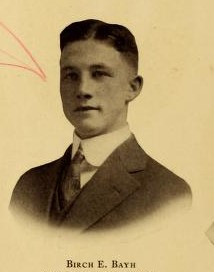
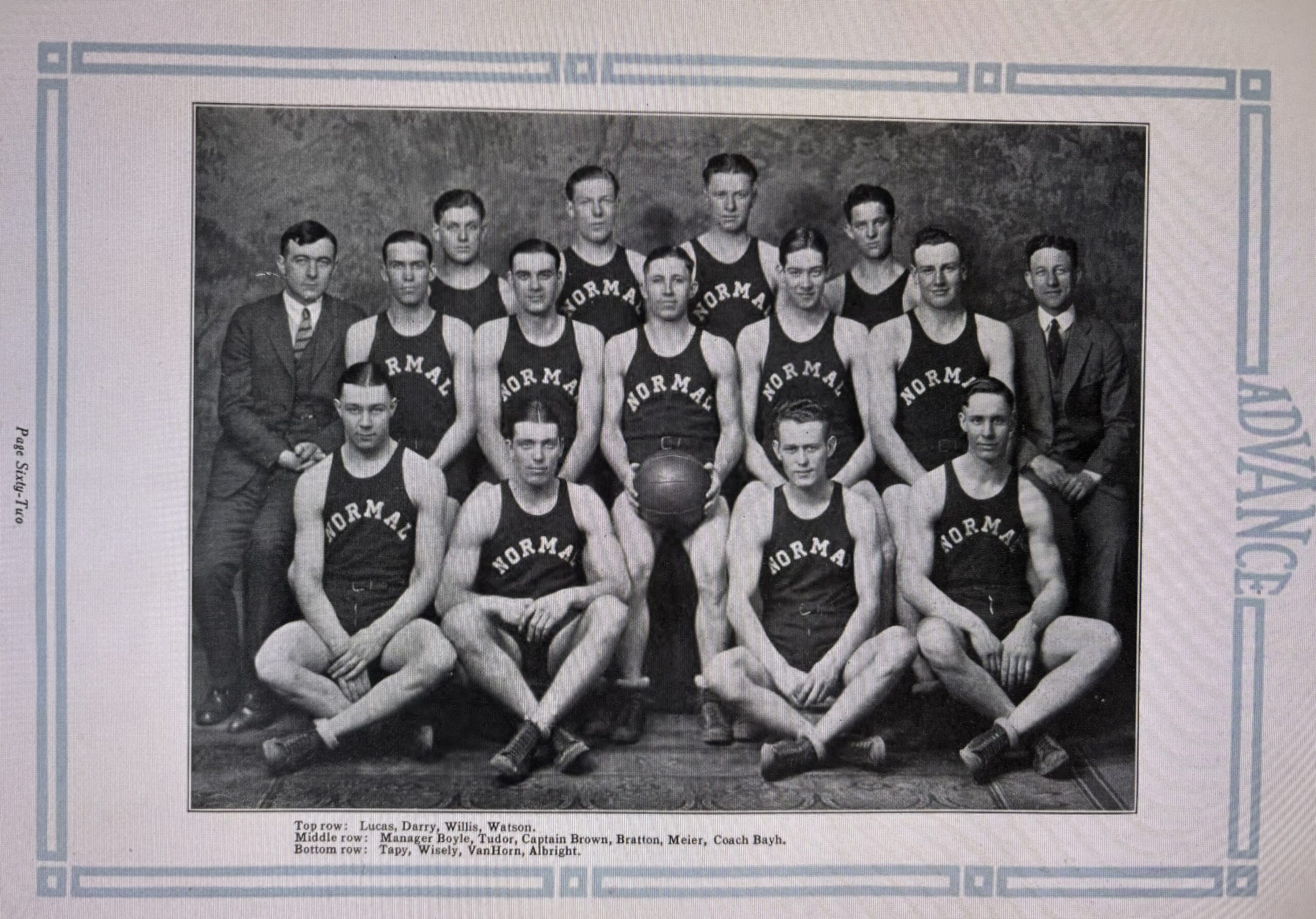
He worked hard and thrived at Clay City High School, doing well in both academic work and in sports. Graduating in 1911, the first year of the Indiana high school basketball state tournament, he trekked to Terre Haute and became a student at Indiana State Normal College, an important teacher training school in the region. A physical education major, the popular Bayh became a top student and the president of his senior year class. He was tops in sports as well.
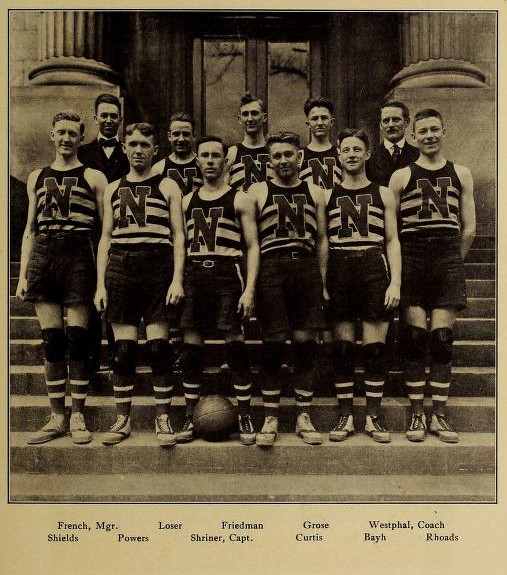
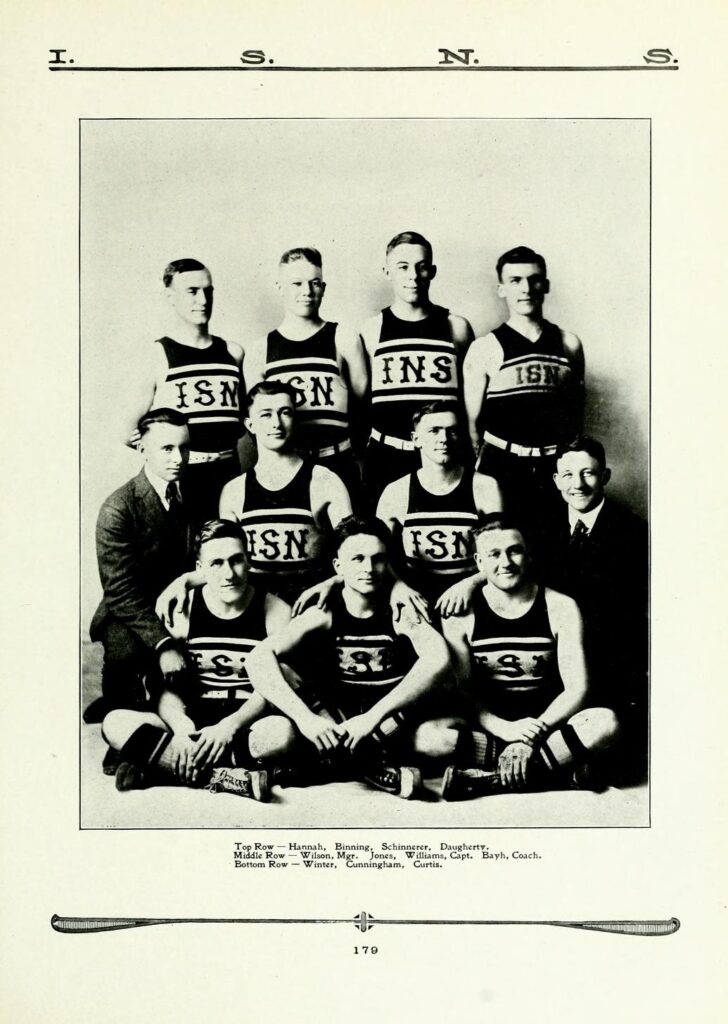
Coach Alfred Westphal guided the Indiana State basketball squads and would achieve a 47-23 record at State from 1912-1917, this span including Bayh’s entire time at Terre Haute as a college player. Indiana State opposition included, among other schools, Earlham, DePauw, Butler, Wabash, Central Normal at Danville, Rose Poly, and Franklin.
Few college teams had official mascots at this time, and Indiana colleges with religious affiliations were labeled by sportswriters as the “Fighting Baptists” (Frankin College), the “Methodists” (DePauw College), and the “Quakers” (Earlham College). The Indiana State Normal team were usually labeled the “Teachers,” but there were other occasional labels used too, such as the “Pedagogues” and the “Normalities.”
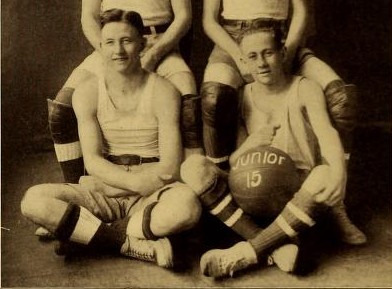
But whatever you called the State Normal squad, one of their main leaders was clearly Birch Bayh.
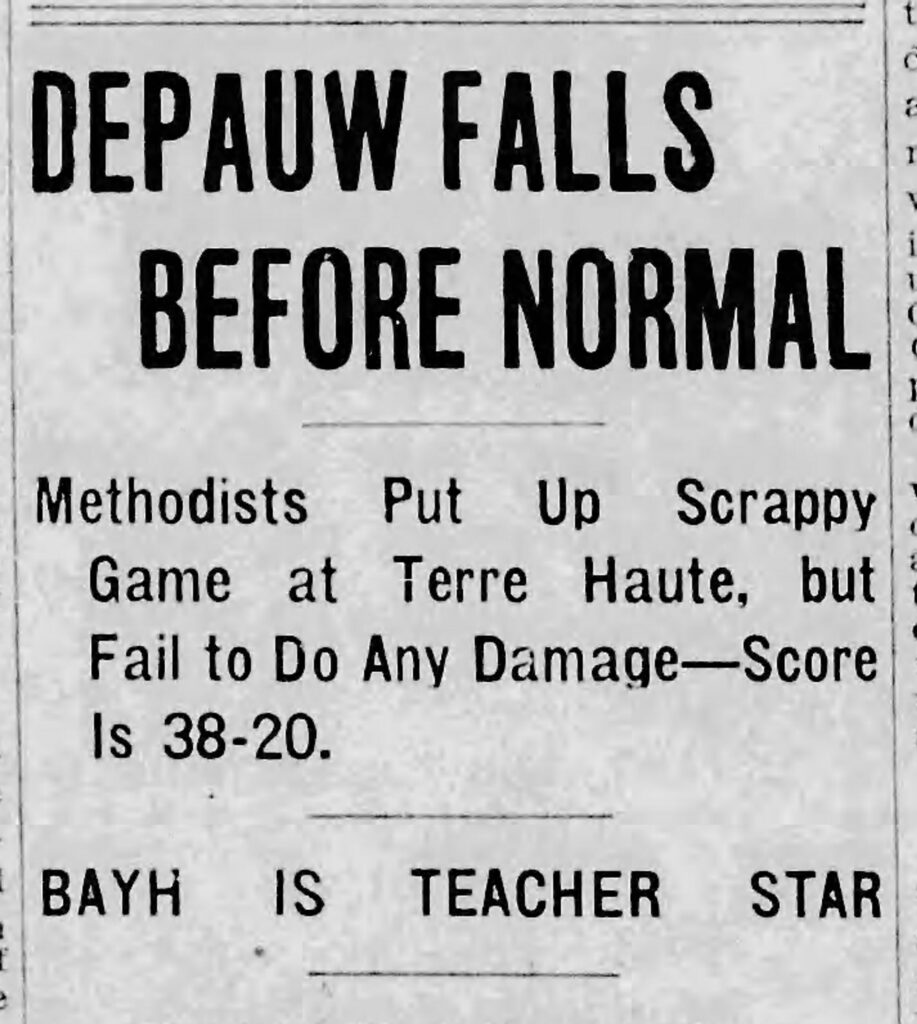
One sportswriter wrote in 1916 about the Normal school’s victory over DePauw, the subtitle proclaiming, “Bayh is Teacher Star.” The piece went on to explain how Birch was “the best of any on the floor. He played forward the first period and guard in the last half and made fifteen of the points counted by the Teachers.”
Against Southern Illinois Normal, another victory for State, the plucky Bayh was again the high scorer. In a game against Franklin Fighting Baptists, the Franklin Evening Star reported that the hard-working Bayh scored half of his team’s points. The entire team from Terre Haute also worked together well, playing, according to the Franklin paper, “some of the fastest basketball ever seen here.”
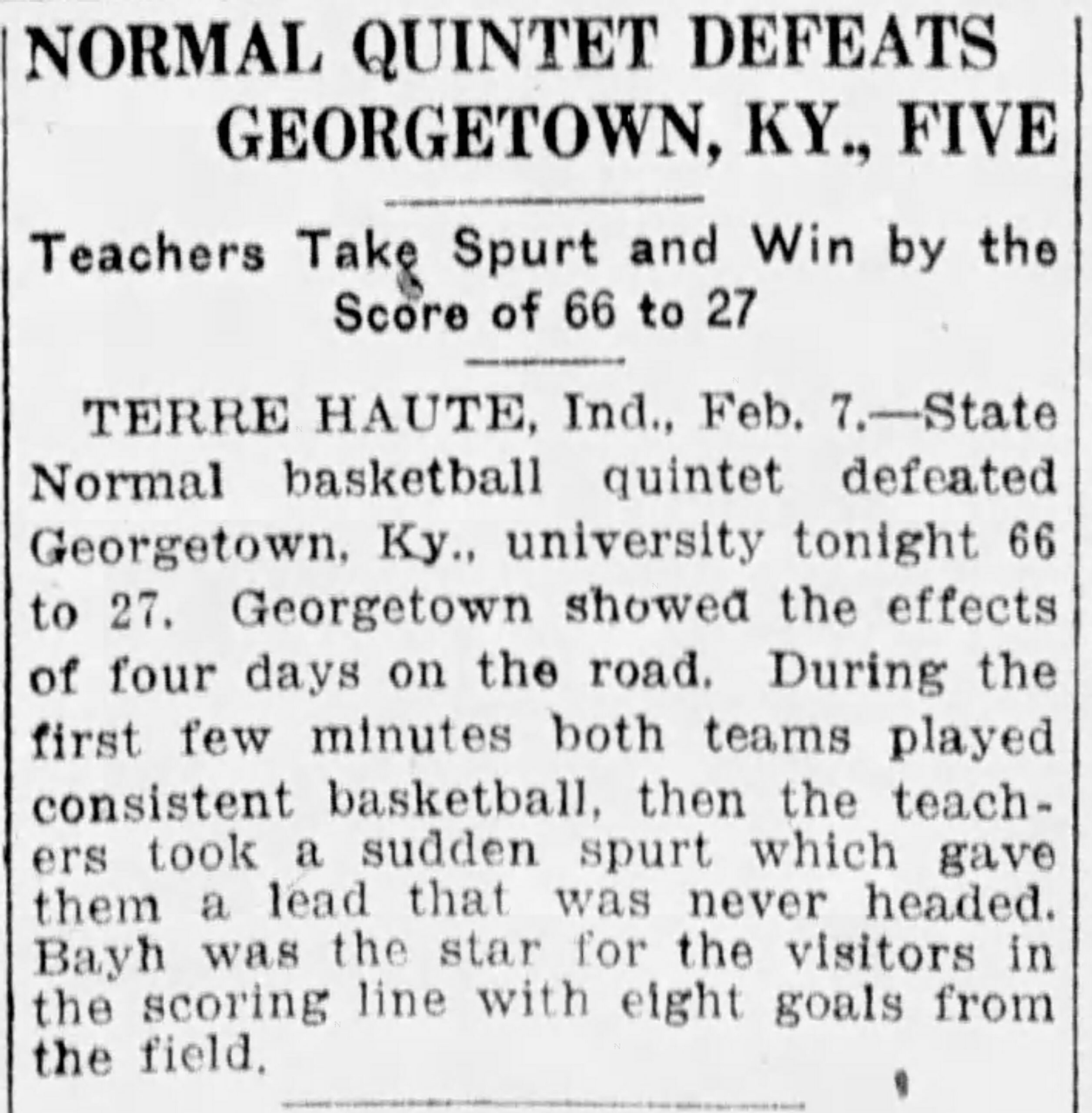
In his senior season Birch Bayh went out with a bang, leading his team in a win over Georgetown, Kentucky. Once more he was labeled “the star,” this time by the Evansville Courier and Press. Led by Bayh, State had its best year under Coach Westphal at 13-4.
Birch excelled at baseball too. The Indianapolis Star ran a nice piece about Indiana State beating Indiana University in a baseball squeaker, 4-3, Bayh getting a sacrifice hit and a key hit in the game. In a loss to Franklin, the Indy Star called Bayh’s fielding “the feature of the contest.”
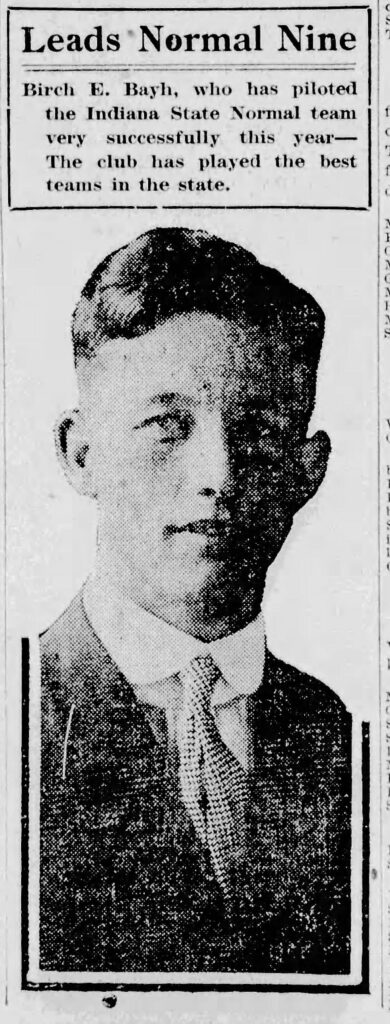
Highly respected for his hard work, people skills, and academic accomplishments, Birch Bayh was hired as the assistant physical education director while finishing his last year of college. The WWI draft, however, took him away from campus in 1917. He returned as an army reservist in 1919 with the rank of major. His intelligence, sincere dutifulness, and commitment to serving the community was recognized again when the twenty-six-year-old was chosen as the school’s first athletic director and head coach of basketball, baseball, and track.
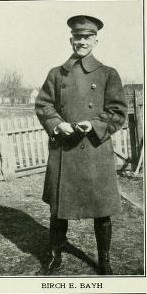
A populist at heart, Bayh got down to business making sports an important part of the campus and more available for students. The Indianapolis Star reported, “Sports at Indiana State Normal have taken a great spurt since Birch Bayh has taken charge of athletics. His idea is to have sports for the masses rather than all of the concentration being placed on varsity sports.” Bayh also added more and better competition to the basketball schedule and brought more games to the campus. State, however, seemed to be behind in terms of playing facilities and remained that way for a long while.
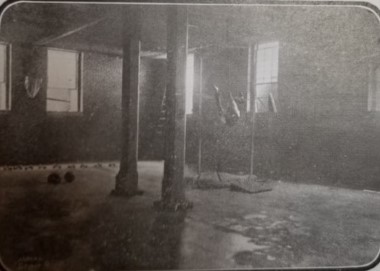
In 1905, the Indianapolis News reported the Indiana State gym was “miserable for basketball, being poorly lighted and obstructed by large posts in the middle, the baskets and banks not of regulation size.” In 1912, an Indianapolis News article suggested home games, because of the small campus gym, were now played at the Terre Haute Boys’ Club gymnasium whenever possible. However, a 1915 report in the Richmond Items revealed State still had occasional games in their cracker box gym on campus, the college gym still containing, “two posts immediately in front of goals and lighting facilities poor.” Another Richmond paper complained that when Earlham College played there, “because of the nature of the floor, it was impossible to make long shots at the goal.” Much of this would change when Bayh took the reins.
In 1919, Birch Bayh arranged for home basketball games to be played as often as possible in a larger gym, at the K of C Hall in Terre Haute. On the roomier court, the novice coach guided the Normal team to more victories than losses in his first season. In 1920, Coach Bayh scheduled the first five games away against college teams who had larger gym floors. This was a strategy to prepare Bayh’s troops for a tough twenty game season ahead. Meanwhile, the game itself was also poised for change, especially when it came to Indiana high school basketball. At the cusp of this boom, a 1919 newspaper report mentioned Birch Bayh as refereeing a basketball game between the college’s Normal High School and Vincennes High School. This may have been his first official high school refereeing job. Other officiating jobs followed that year.
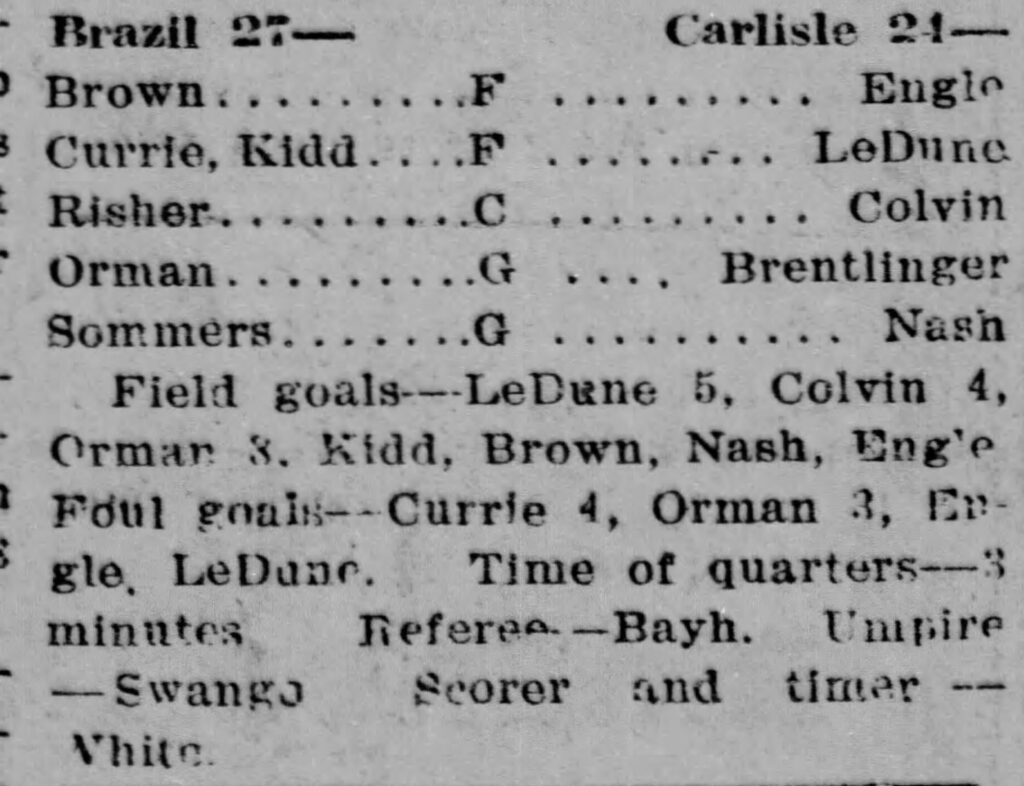
It’s interesting to ponder what moved Birch Bayh to get so involved in officiating high school basketball contests. In Indiana, where every fan thought themselves a better coach than the ones on the floor, referees were often reviled. Running up and down the gym floor, shouts of “get some glasses!” ringing in their ears, refs had to keep complete concentration on the action, making calls in a split second and with confidence, any hesitation raising doubts. At best, fans would leave a game holding only a few grudges about a ref’s “bad calls” before they were quickly forgotten. (There was also a variation of the bad call known as the “no call.”) At the very worst, fans on one side would swear a bad call made the difference in the game.
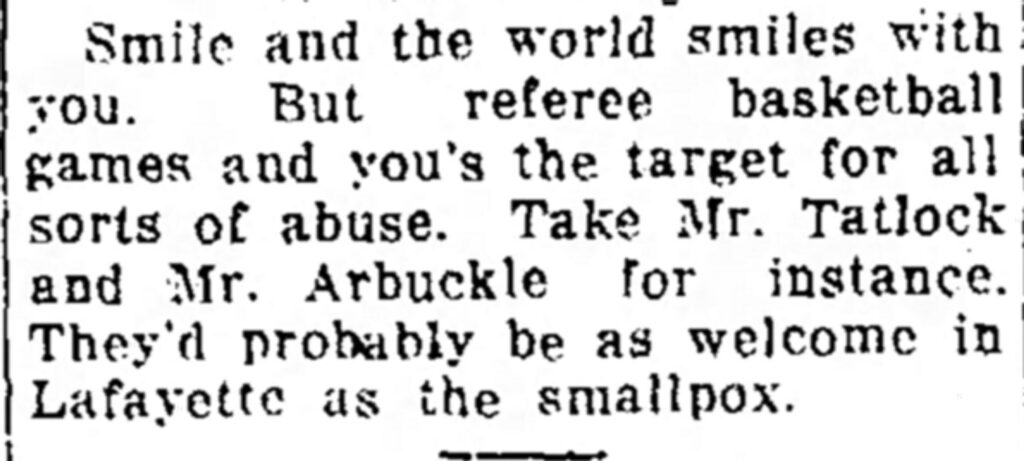
In short, the job of the basketball referee was a loveless task, essential, but difficult. No one would ever call a referee a hero.
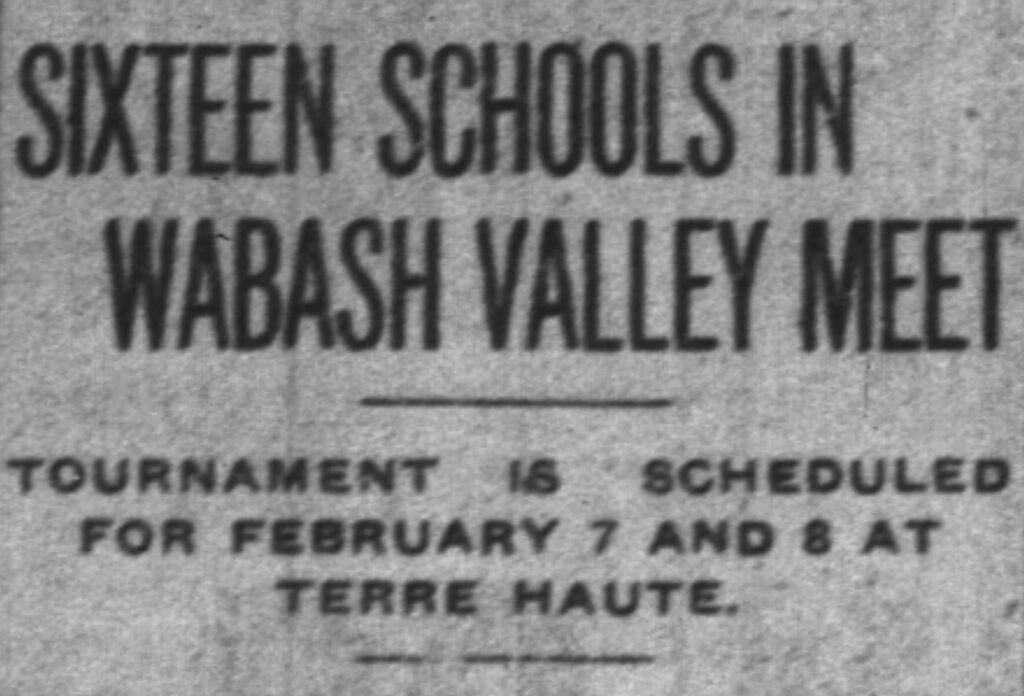
Bayh’s most impressive officiating that 1919 season probably occurred at the sprawling Wabash Valley Tournament, a sixteen-team affair perhaps second only to the state finals. It included schools on either side of the Wabash River that touched Illinois. Bayh’s strong presence there, his steady calls, caught the attention of many high school principals and superintendents. His own college coaching, however, was suddenly taking up more energy as his teams continued to get better.
In his fifth season of college coaching, 1922-1923, Bayh hit the jackpot, the “Teachers” winning twenty games out of twenty-five. It was the first twenty-win season in the school’s history. Meanwhile, his high school refereeing was picking up. In December, at the beginning of the 1922-1923 season, he officiated in a county tournament up by Lafayette. That referee Bayh and his partner were in total charge of the games can be seen in a report in a Lafayette newspaper. “The officials in charge deserve credit for their business-like manner in which the affair was conducted. Bayh and Hurly did excellent work and added greatly in making a success of the event.” This was followed by work in the Johnson County tournament and then, the best of all, at the Vincennes sectional, his first state tournament level job.
The next basketball year, 1923-1924, Bayh was in high demand as a referee due to his steady, confident officiating. He had more time too, having moved from Indiana State to become the head of the Terre Haute public school system. He had been a hurried one-man show at Indiana State, conducting college classes, coaching three sports, and speaking at endless public school teacher retreats. His new job gave him more control over his time, giving him more energy to referee.
Birch Bayh worked many games in the Terre Haute area that year, including the most interesting contest in the regular season, Vincennes against the Bedford five. The latter squad was said to be the best high school basketball team in the state that year. Again, Bayh officiated at a sectional, this time at Martinsville in late February. Vincennes fans hated to lose him, a local paper reporting Bayh was a “popular referee.” In March of 1924 Bayh finally went up the ladder, officiating at the Bloomington regional in the spacious IU gymnasium where his efforts were heralded in a news report as “very commendable.” And in a world where Indiana high school basketball fans could get fired up enough to be threatening, Bayh was called by another newspaper “A fine fellow personally. A good official who knows the game.” It was a very rare compliment for a ref.
An article in the Vincennes Sun-Commercial summed up Bayh’s court confidence and intensity when it came to controlling one particular game, a contest of “petty holding, touching, and guarding kinds of fouls.” The paper declared, “Mister Bayh didn’t miss any one of them.”
But for all the compliments, Birch Bayh, at thirty-one years of age at the end of the 1924 basketball season, had yet to make it to the high school refereeing pinnacle, that of officiating at the state final tournament in the cavernous state fair fieldhouse in Indianapolis in front of 14,000 screaming fans. But the next year would bring glory beyond Bayh’s ability to imagine.
The early 1920s set the stage for the moment in 1925 when Indiana was crowned the nation’s high school basketball state by none other than the game’s inventor, James Naismith. The decade started with the Wonder Five, the Franklin High School team from Johnson County under Coach Ernest “Griz” Wagoner. The school gained three straight Indiana state championships— 1920, 1921, and 1922. The skills, teamwork, and comradery of those three thrilling squads captured the state’s imagination and made the state tourney the biggest yearly event in Indiana.
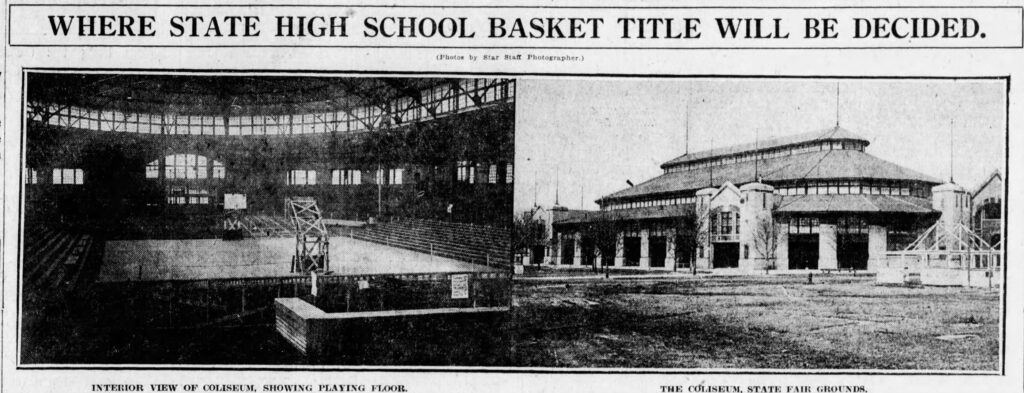
As the game exploded in popularity, the question of where to hold the final high school championship round emerged. Indiana University laid claim to the finals for many years but by 1921 the number of teams and fans took the state tournament to a more central location with a larger seating capacity, the coliseum at the state fairgrounds in Indianapolis. It was a bit of a rigged affair, The baskets were portable and the backboards wooden, blocking out the view at times for some fans. But the crowds were massive anyway.
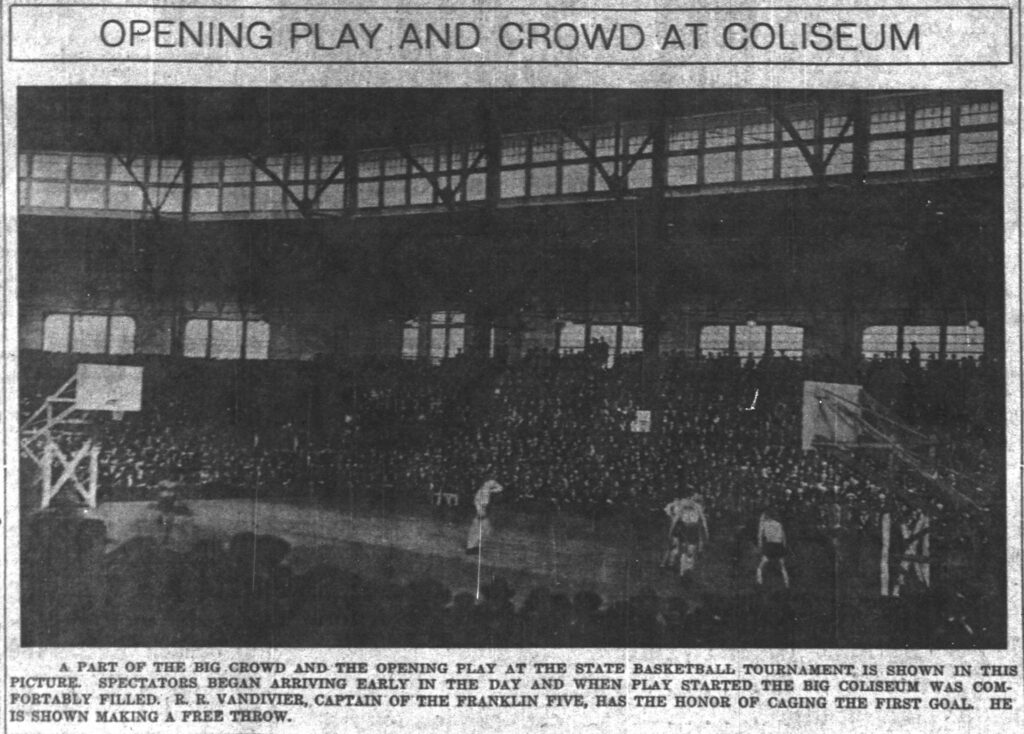
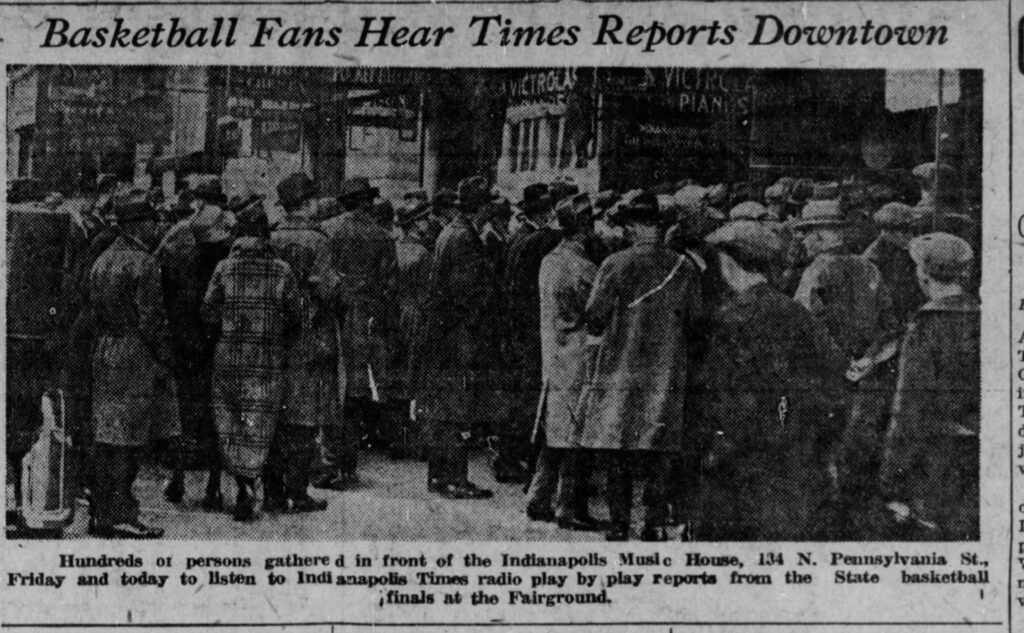
It dd not hurt Indiana high school basketball popularity either that more cars and better highways had appeared, and short train and tram lines veined the state, allowing for the travel of large numbers of fans to big games. The presence of radio also accelerated the interest of state final play, allowing thousands of people to all but be there. In some cases, telephone calls from the games at Indy were made back to packed gyms of fans who couldn’t travel or get tickets. Someone would run from the room where the phone was located and announce the most recent information about the contests to a gym full of excited fans.
In 1923, the year Birch Bayh got his first sectional refereeing gig, Vincennes won the state crown. The next season, in 1924, Martinsville pulled off the trick, coached by Glenn Curtis, a graduate of Indiana State, while Bayh continued to expand his referee work. The next year was a prime one for Bayh. He was called a “handsome referee” in the Indianapolis News, the Vincennes paper describe him as being kind, patient, and generous with contrary players, and the same paper also noted, “nothing gets to Birch Bayh.” But the best was yet to come.
In the early spring of 1925, a Kansas newspaper declared that state “The basketball capital of America.” The story was picked up by other newspapers across the nation. The article pointed out the state had won the national A.A.U. title, the state’s flagship university had a record of 61 wins out of 64 games in the last four years, and Wichita High School had captured the national high school title at the University of Chicago’s high school national tourney. “And, to further the prestige,” the article finally bragged, the inventor of basketball, James Naismith, “has been a professor at the University of Kansas for many years.”
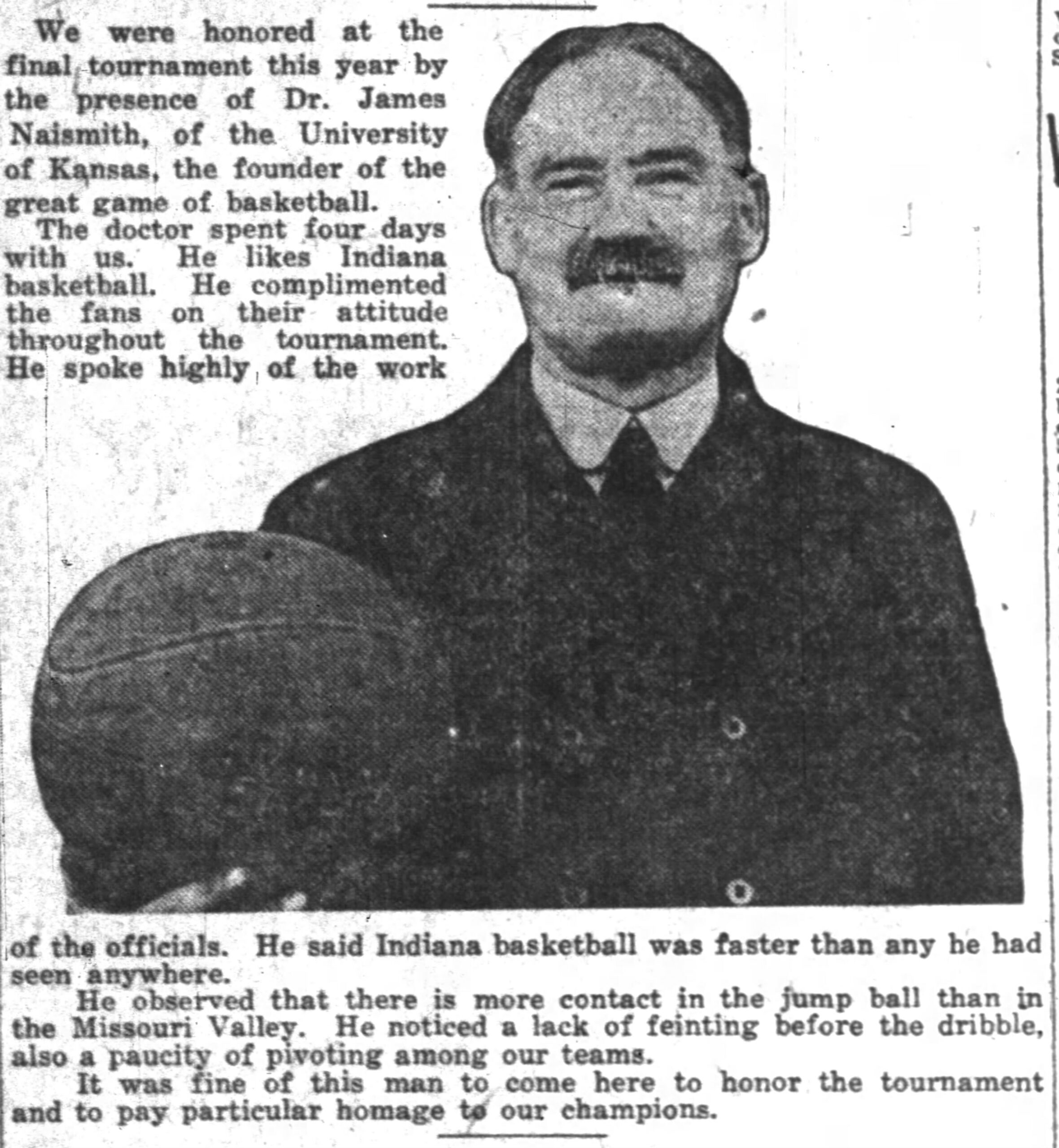
In fact, Naismith was traveling to Indiana that very spring, having been invited by the committee that ran the Indiana high school basketball state tournament to see how the game was played in Hoosierland. Naismith would attend two long days of games, along with 14,000 frantic fans present for each game. He sat on a special bench placed in one corner on the gym floor. Behind him sat other out of state dignitaries such as Walter Meanwell, the coach at the University of Wisconsin, himself, another famous innovator of the game.
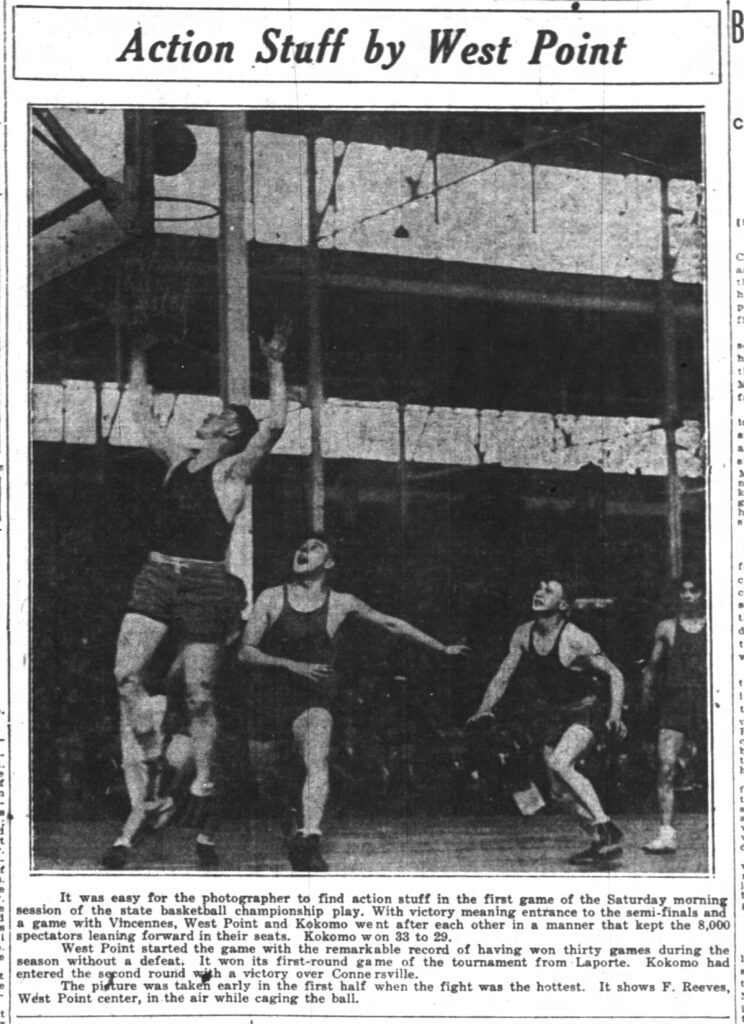
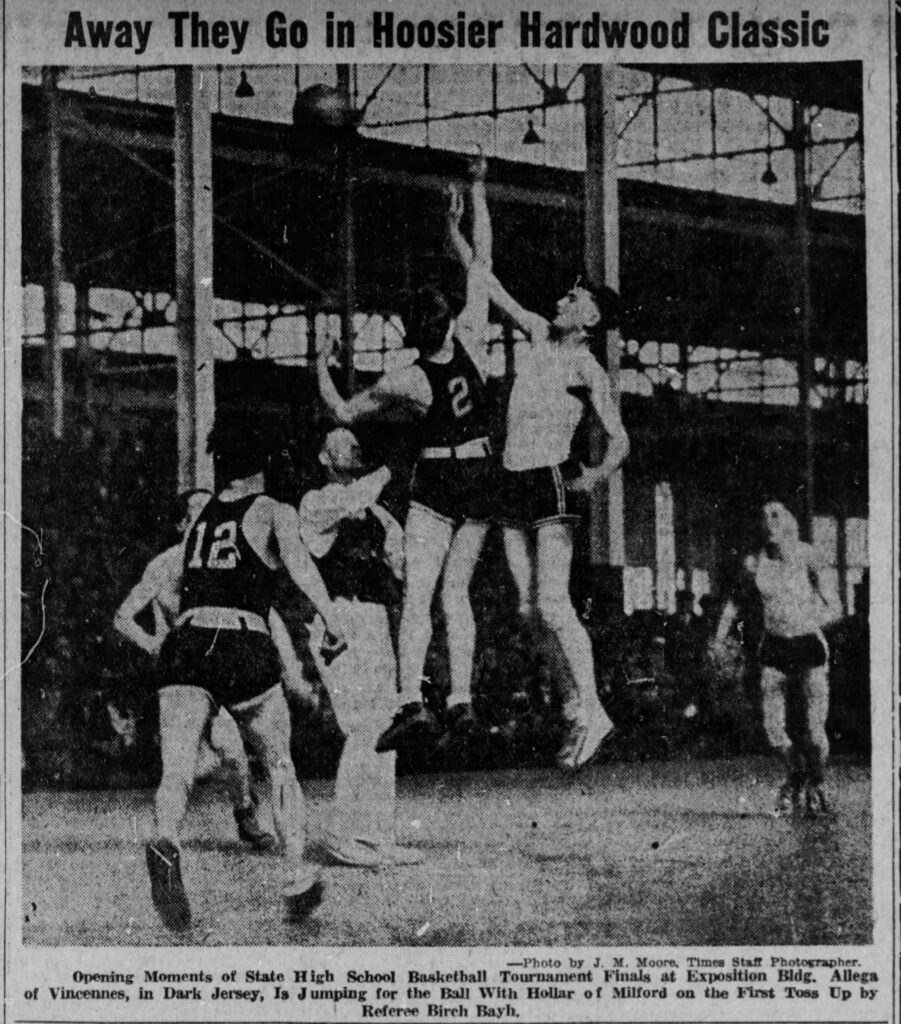
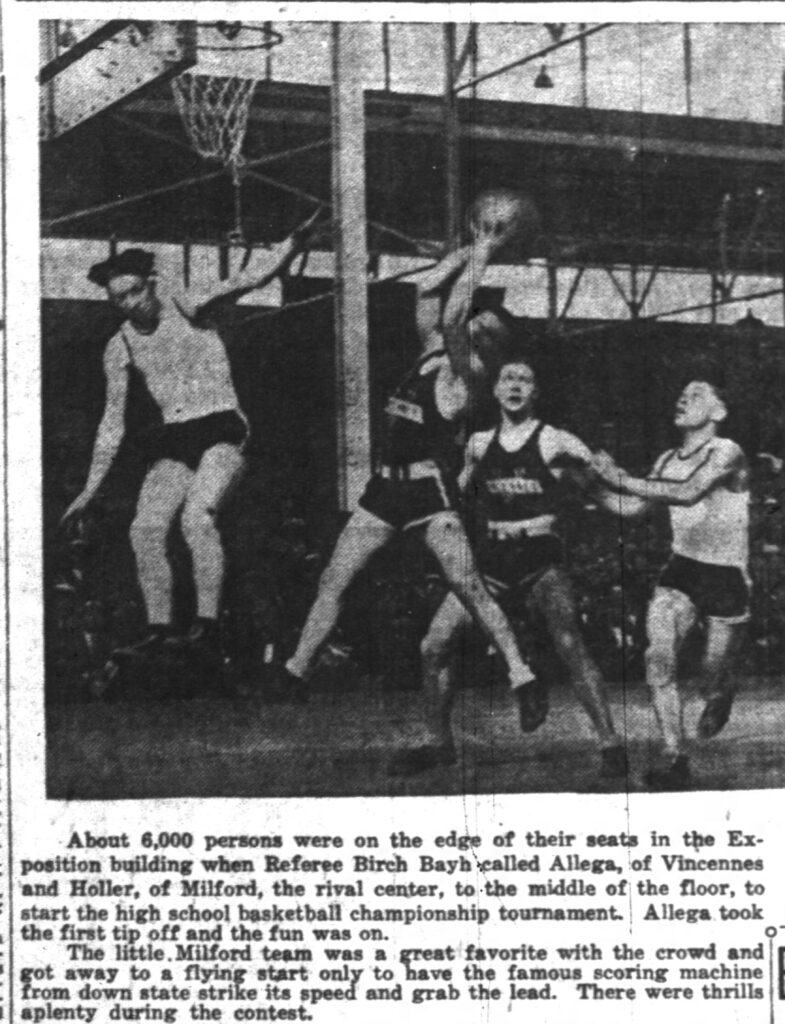
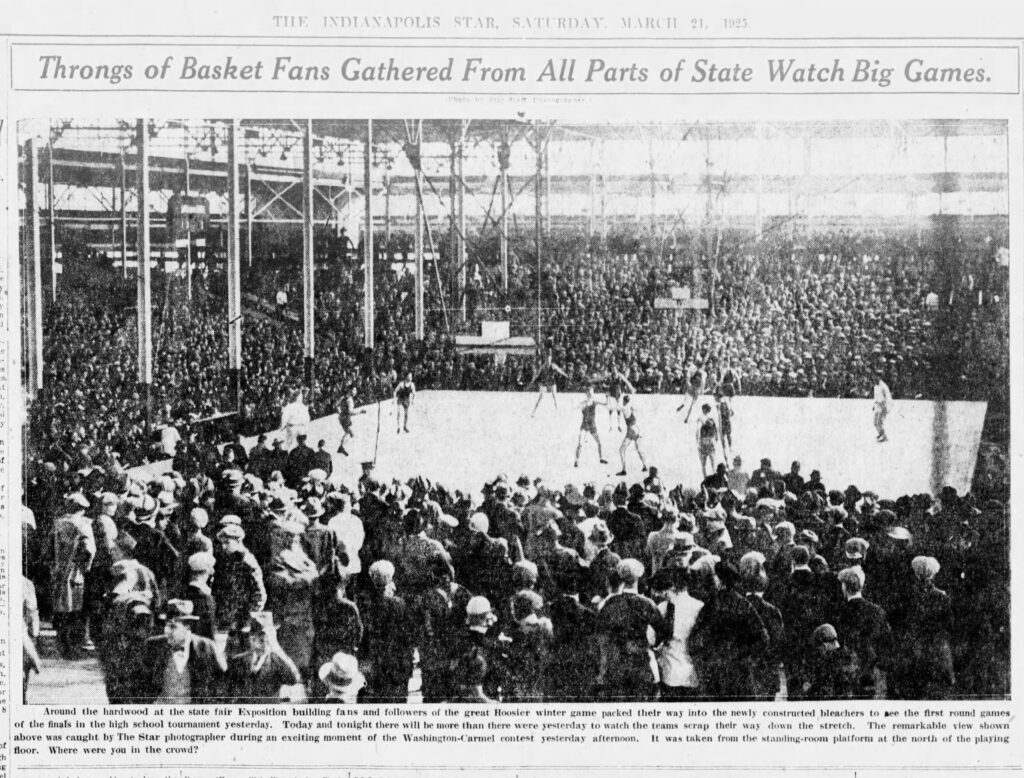
Shortly before Naismith received his unexpected invitation, Birch Bayh received some electrifying news. He had finally been selected as one of four high school referees who would work the 1925 state tournament games. In fact, he would throw up the first jump ball of the first contest between the top contender, Vincennes, and tiny Milford High School, the people’s choice. Hoosier high school basketball followers loved both the teams with machine-like precision and the scrappy, little-school underdog squads. But when faced with both types playing each other, Indiana folks typically gave in to their egalitarian impulse and rooted for the little guy. Milford had most of the crowd’s support even before they ran out onto the floor for the first morning’s contest. The Indianapolis Times noted that while fan capacity was said to be at 10,000, fourteen thousand had somehow been squeezed in.
(Indianapolis News, March 21, 1925)
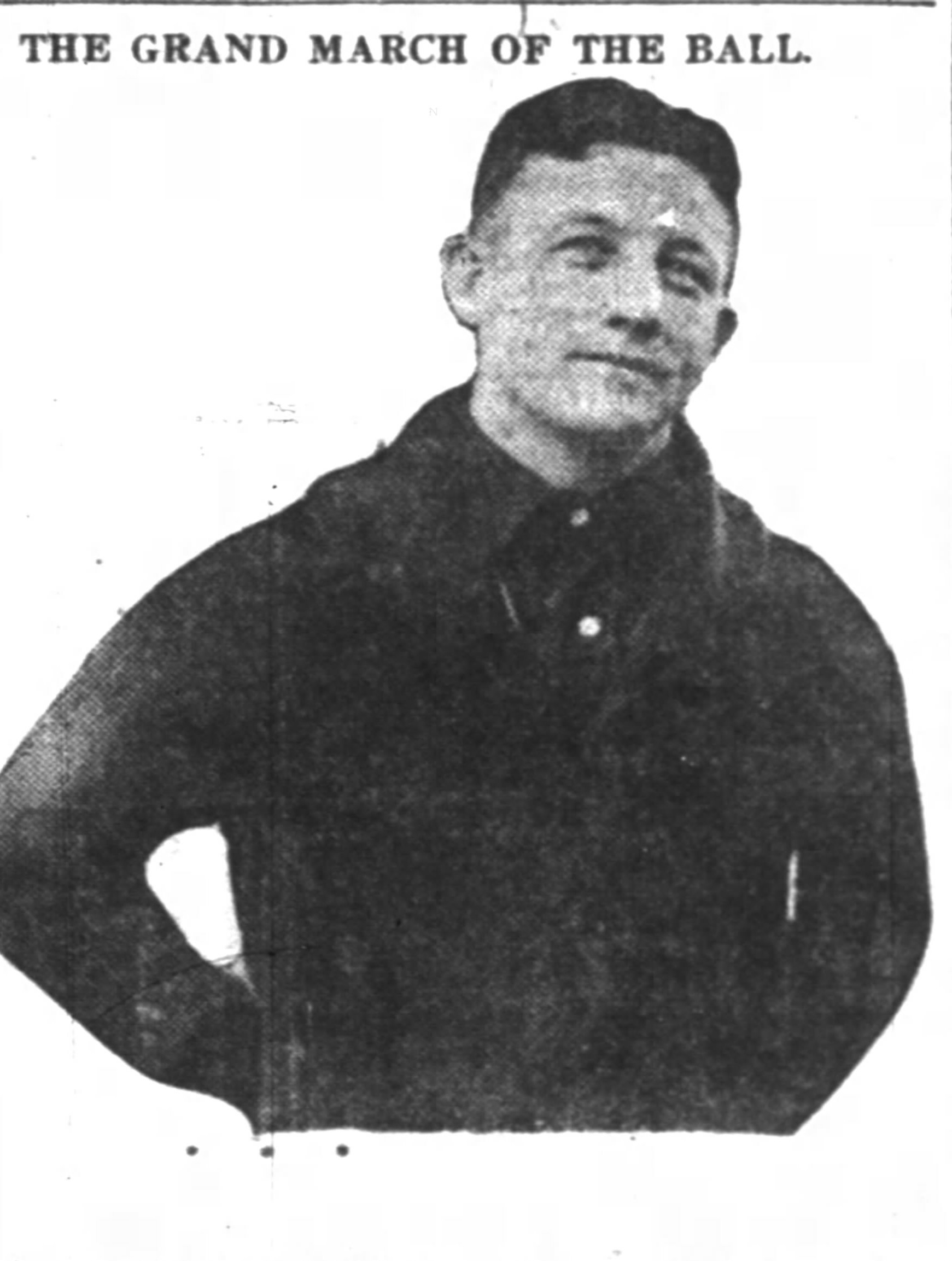
Just before the tournament began, a bored sportswriter for the Indianapolis News, who possibly may have been drinking, wrote a long verse about the upcoming first game between little Milford and mighty Vincennes, the latter picked to win the championship. The Vincennes team, called the Alices after the story Alice of Old Vincennes, was feminized in the narrative. The writer compares the tourney’s first game to a surly boy taking a girl, who can take care of herself, to a ball. Bayh is described as the person who starts the ball. With a photo of the handsome Bayh included, the piece, titled Birch Leads the Grand March of the Ball, ends with a prediction, “The female of the species is more deadly than the male. And that, ladies and gentlemen, is why we’re pickin’ Alice, which translated into basketball in Indiana is Vincennes.”
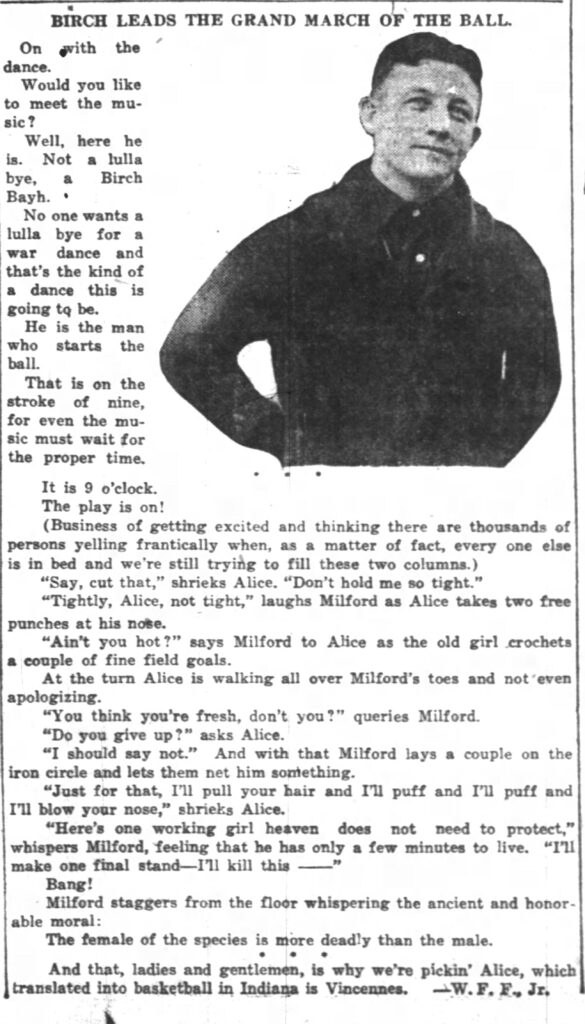
As for the real Birch Bayh, he was as nervous as a cat anyway, but the news of Naismith’s attendance surely left him petrified. It didn’t help that the gym and seating area set aside for tourney battles in the fairground’s colossal pavilion was filled with thousands of hollering fans. One thing that might have put fans in a good mood was the fact the backboards were now made of glass, so everyone had good views of the game.
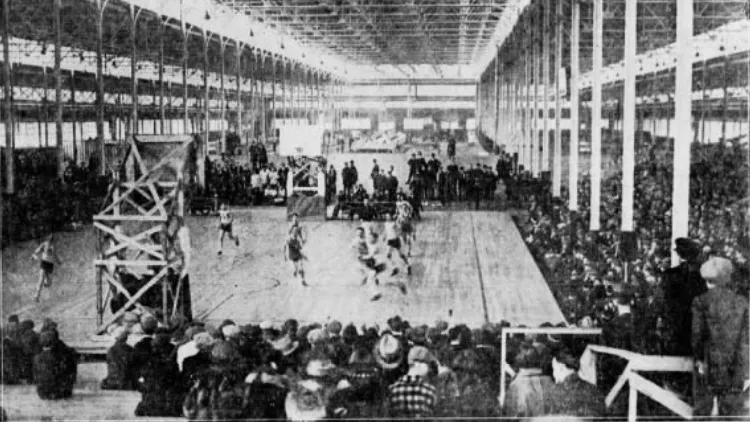
Vincennes came out on the floor first, and a sportswriter noted how the green clad team “went through a brisk five-minute workout. The boys were snagging baskets from far and near, and every swish of the net brought a roar of approval from the Vincennes stands.” The Milford team spilled out on the floor a few moments later, followed by another wall-rattling roar of approval.
Then the gym went silent when a calm, in charge, Birch Bayh stepped up to toss the ball in the air. No nerves now. Bayh was in full refereeing mode. The 1925 Indiana high school state tournament had begun.
The real thrill of that first game occurred, accounting to the Indianapolis News, in the final period. Milford had pulled up close to even with Vincennes and the latter team called “Bayh to halt the game until the Milford boys could cool off.” Vincennes eventually won the initial tourney contest but lost in the semifinals.
After his officiating was over in the first contest, Birch Bayh showered and went to introduce himself to James Naismith. One sports reporter observed that Naismith sat like an aged (he was 64) and proud father “on a little bench at the northeast end of the playing floor,” watching the intense games unfold.
Forty years later Birch Bayh told Evansville Press sportswriter Larry Stephenson how he came to timidly sit behind the inventor of basketball just before the next contest began. “When the next game got started, I was ready to talk about offenses, about defenses, about strategies. I was preparing myself for the father of basketball. I thought he’d want to talk.” Bayh tapped Naismith on his shoulder.
Somewhere during Birch Bayh’s’ rambling monologue, Naismith suddenly turned his back on the young ref to watch the game. Bayh was stunned. “I was just talking to myself.” Not knowing what to do, he sat back and watched the game.
Birch Bayh would eventually call ten state basketball finals, including a record seven Indiana state championship final games. Then there were the countless games in regular seasons spanning a period from 1919-1935. Bayh estimated he made about $3.00 a contest, which wasn’t bad. As he later told a sports reporter, “I had to have some extra change to raise my family.” But 1925, however, was a very good year, the likeable Terre Haute ref making $30.00 for two games at a big Vincennes tournament, and the Vincennes paper reporting Bayh, “worked in splendid form.” In 1931, an Evansville Courier and Press reporter stated that Birch Bayh was “as good a basketball official as I have ever seen in action.” That same year he was chosen as one of four officials at the state Catholic high school basketball tournament.
Time was the only enemy. By 1933, Bayh had turned forty and may have been slowing down. Perhaps too the game had gotten a bit ahead of him or maybe he was just losing his interest in refereeing. In that year a Vincennes Sun-Commercial piece reported that the officiating of Birch Bayh at the state finals “was the worst seen this year, the game getting rough early and staying that way, with traveling violations and other infractions going without a toot.” A 1934 Jasper Herald newspaper article mentioned a specific incident. “Last year Mr. Bayh slipped on a decision and Hazelton’s chances were ruined. And so southern Indiana says thanks to Mr. Trester for his choice of officials.” Small school Hazelton, from down in southwest Indiana was the popular underdog squad at the finals that year.
In a more humorous episode, the Indianapolis Times told of a dog wandering into a gymnasium during a college game at DePauw in 1934. Referee Bayh kept waiting for someone to take the stray dog out. The animal snapped at Bayh’s heels every time he ran past that way. The paper reported, “Mr. Birch Bayh finally piled up four personals on Mr. Dog as the band struck up “’Git Along Little Dogie.’”
In 1935 the Evansville Press announced in March that Birch Bayh had not been asked to officiate at the high school state tournament. Later that same year, Birch Bayh announced his plans to become the director of Physical Education in the District of Columbia. Bayh would finish his teaching vocation in Washington D. C.
Birch Bayh officiated hundreds of Indiana high school basketball games. But I would like to believe that of all the contests of his fruitful career, the most amazing moment, the story he told to the sports reporter in 1975, occurred when he attempted to talk to James Naismith in 1925 and Naismith just turned away to watch the game. But there was more to the story.
Just after the contest ended, the inventor of basketball suddenly turned to Birch Bayh. Naismith was in a trance of pure joy and wonderment, hands in the air. He leaned forward and told Bayh, “I never thought it would come to this.”